

EN

november 2026
Alexandra Guimarães and Gonçalo L. Almeida spent many nights on the streets and in the squares of Porto, where motorbikes laden with colourful delivery platform backpacks gather. They struck up conversations with delivery drivers, handed out flyers and told them about the film they had in mind. “We wanted to explore the idea of getting to know the city through maps, and a delivery driver’s work is dictated by maps,” explains Gonçalo, who had previously collaborated with Alexandra on two short films, one of which was made whilst they were both studying for their degree in Cinema and Audiovisual Studies at the Porto School of Art (ESAP).
The duo’s regular presence at delivery driver's hotspots made them well known amongst the immigrants in those neighbourhoods and eventually led them to their protagonist. Alam Shah Kazol, owner of Dreams Souvenir – a shop across from Largo da Rua Chã, one of the aforementioned hotspots – and leader of the Bangladeshi community in Porto, publicised the project within an internal group. Mazharul “Akash” Hoque, who has lived in Porto since 2020, expressed an interest in taking part and went to meet the filmmakers.
Up to that point, Alexandra and Gonçalo had collected various readings on “the connection between reality and representation”, such as "On Exactitude in Science", a fable by Jorge Luis Borges in which an empire creates a map that is entirely faithful to its territory. Initially, they envisaged a “more experimental short film based on philosophical ideas”. “Through the fieldwork, the film moved away considerably from the [style of] a theoretical essay,” notes Alexandra.
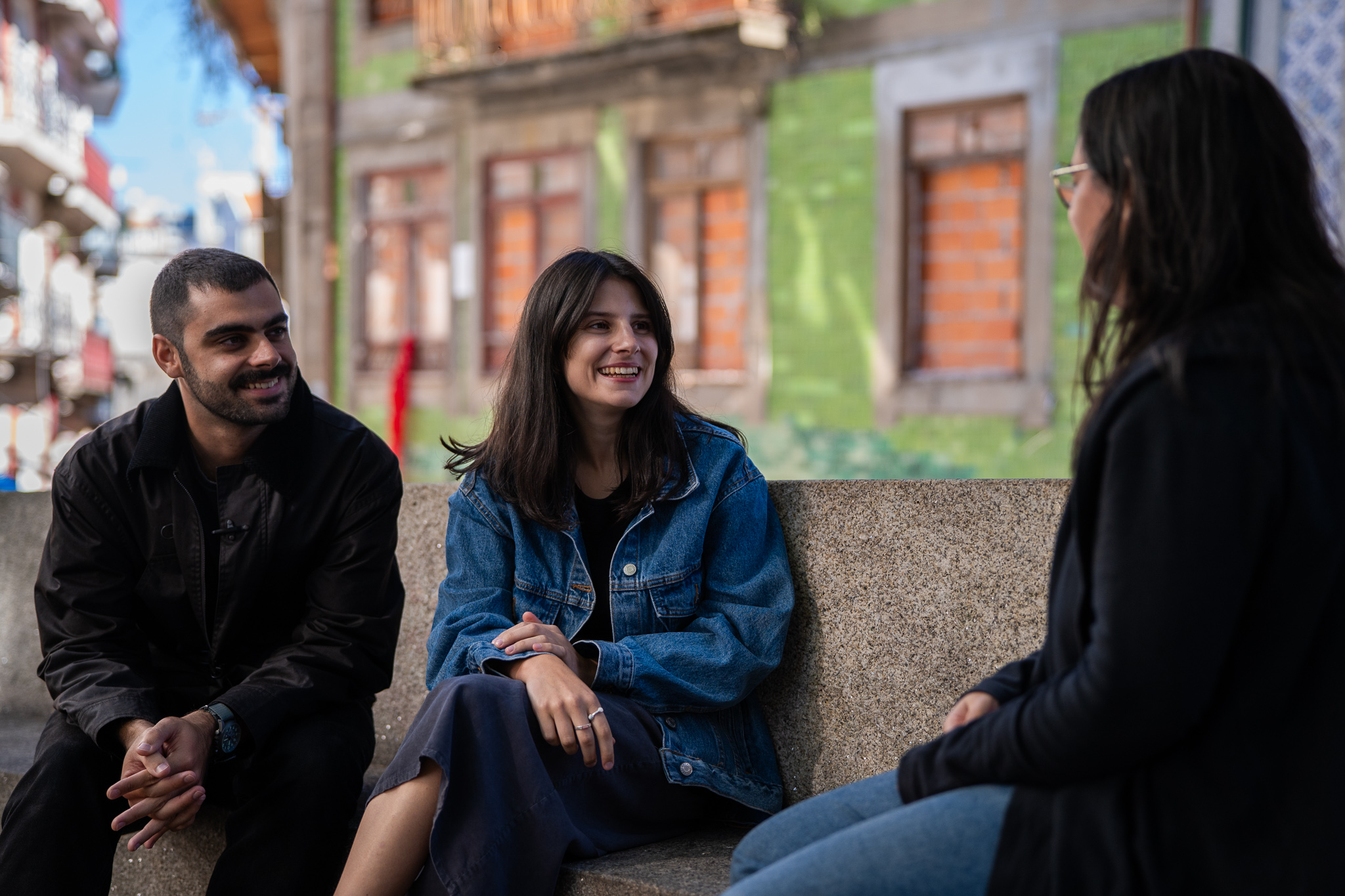
Gonçalo L. Almeida and Alexandra Guimarães © Nuno Miguel Coelho
Although less prominent, the research provided some insights into the filming process and the involvement of those taking part. An example of this is the concept of ‘psychogeography’, a field that studies the impact of the geographical and urban environment on the human mind and behaviour, and one of whose main practices is ‘drift’, that is, the act of wandering aimlessly through the city. “Akash is almost an accidental psychogeographer,” Gonçalo observes. “He is absolutely enchanted by Porto and loves walking around discovering the city.”
The Bangladeshi fit perfectly into the portrait the filmmakers sought to paint of the transformation of the city and of work in the age of digital globalisation — including the underworld of precariousness and exploitation that it generates — but his contribution added an extra layer. “We wanted to work with a delivery driver because he’s almost a slave to maps, but he showed us that he’s no slave at all and that he knows the city far better than we do,” points out Alexandra.
Work routes and guided tours
The film follows Akash’s routes and detours whilst working for a delivery platform, but also illustrates his personal connection to the city. The aforementioned Largo da Rua Chã, one of the key filming locations, holds great emotional significance for the immigrant. When he moved to Porto, he rented a room right next door. After leaving the neighbourhood, he continued to practise his faith at the Hazrat Hamza Mosque, further down on Travessa da Rua do Loureiro.
“We wanted to follow his work routes, but also look for places where he chooses to spend his time,” says Gonçalo. “That inevitably led us to the mosque, because he is very religious.” Their wish to film there grew even stronger when the filmmakers discovered that the building housing the mosque had been bought by Lionesa, the owner of Lello. The worshippers would have to vacate it by 31 October. “We felt an even greater sense of urgency to capture this atmosphere.”
The selection of locations to be filmed was also determined through contact with Pedro Figueiredo, an architect, guide and co-founder of The Worst Tours – guided tours that reveal the city’s unknown and less ‘Instagrammable’ side, sparking debates on housing, tourism and gentrification. To discuss the globalised city, it was necessary to bring tourism into the conversation; Pedro’s tours provided the ideal setting. “We didn’t want to do it in a satirical or superficial way,” the director emphasises.
In this sense, these tours run parallel to the routes taken by Akash, entering into a dialogue even without physically intersecting. “Tourists reflect on what is happening and share experiences from their own cities,” adds Gonçalo, warning that the reshaping of cities by “larger digital systems” is a cross-cutting issue.
Throughout the process, the filmmakers sought to “understand how digital platforms exert a real influence on the area and on the city”. The hidden influence of platforms such as TripAdvisor and Airbnb “defines what makes sense in each place from an economic perspective and in terms of the flow of people”, argues Alexandra. “Suddenly, it makes sense to create a new cultural hub here [around Largo da Rua Chã], but for whom?”
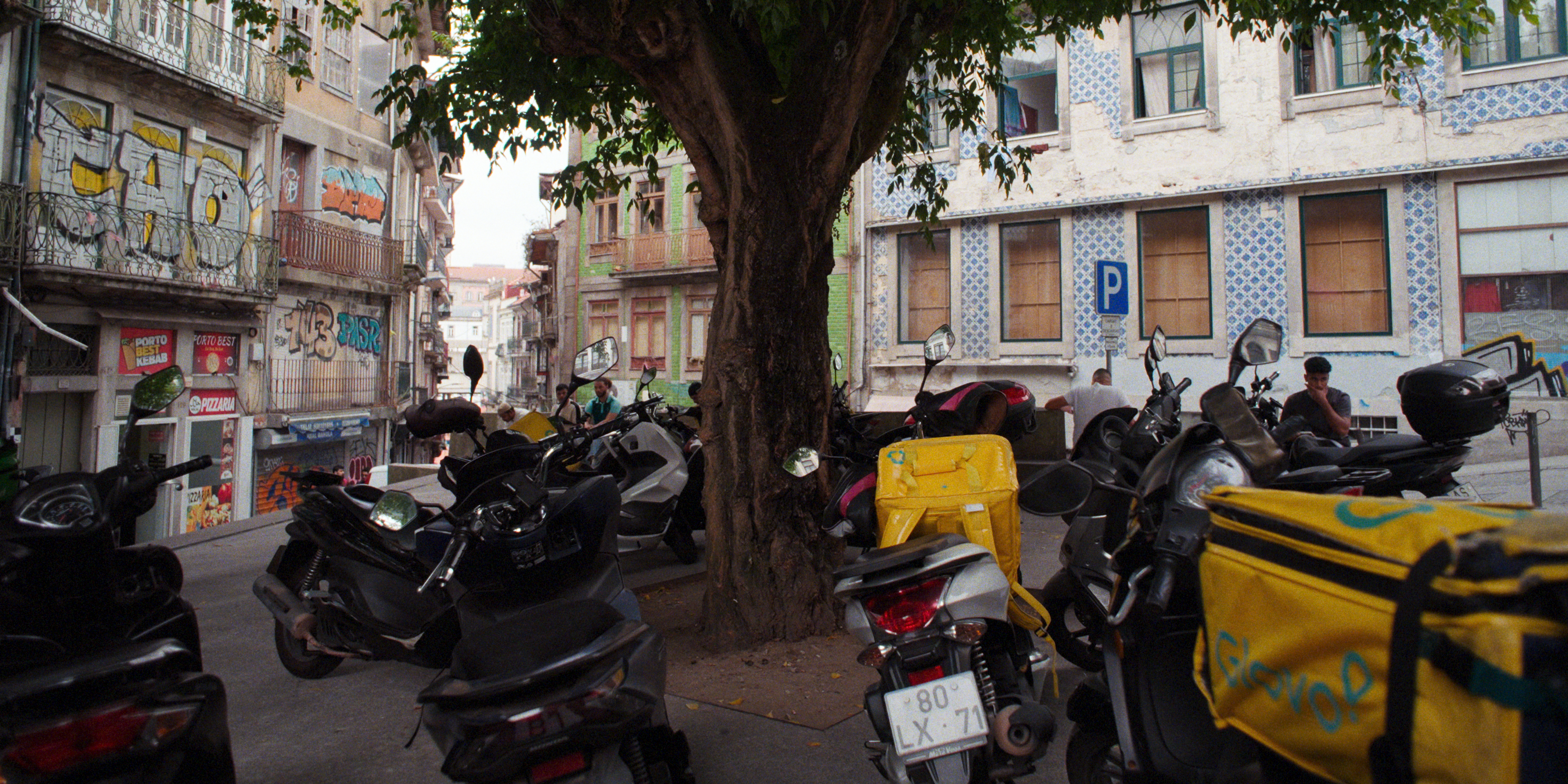
Largo da Rua Chã in The City and the Maps © Alexandra Guimarães and Gonçalo L. Almeida
Seeing and filming the city from below
The filmmakers’ experience as tourists and users of digital maps allowed them to realise that what they were seeing was nothing more than a curated version of a place. “We were interested in seeking out what lies on the margins,” Gonçalo reiterates. Consequently, it was necessary to shift the perspective of the maps, which force us to “view the city from above and erase the reality of those who live there”.
The City and the Maps presents itself as a counter-image to the ‘postcard city’ that has taken the world by storm over the last decade. “There is a ‘brandification’ of contemporary cities, and Porto is a good example,” observes Alexandra. “The image of the city has certain elements, and we sought to move away from all of that.” The abundance of images of Porto guided the intention behind each shot. “If certain images are created in a particular place, how can we create a more real and authentic picture of what is actually happening?”
To bring their vision to life, the duo chose to film using 360° cameras mounted on Akash’s motorbike, creating an image reminiscent of the aesthetic of Google Street View or a video game. “The logic of surveillance and control to which this character is subjected [by the digital platforms that are his livelihood] is implied,” explains Alexandra. Various 3D renderings from Google Earth are used, juxtaposing the real city with the virtual one.
The City and the Maps premieres on the 19th in Sala 1 at the Batalha Centro de Cinema and is the result of two years of production made possible by the Working Class Heroes grant. This grant, worth 75,000 euros, is awarded annually by Porto/Post/Doc in partnership with Filmaporto — Porto Film Commission and with the support of the “la Caixa” Foundation, through CaixaForum+.
Share


