

EN

May 2026
Expert listeners, babies are increasingly taking centre stage in the city’s cultural offering. Highly sought-after and regularly sold out, music sessions for babies are moments of contemplation and connection between families, strengthening bonds and fostering an appreciation for art and one another. Agenda Porto presents six projects that bring music to little ones.
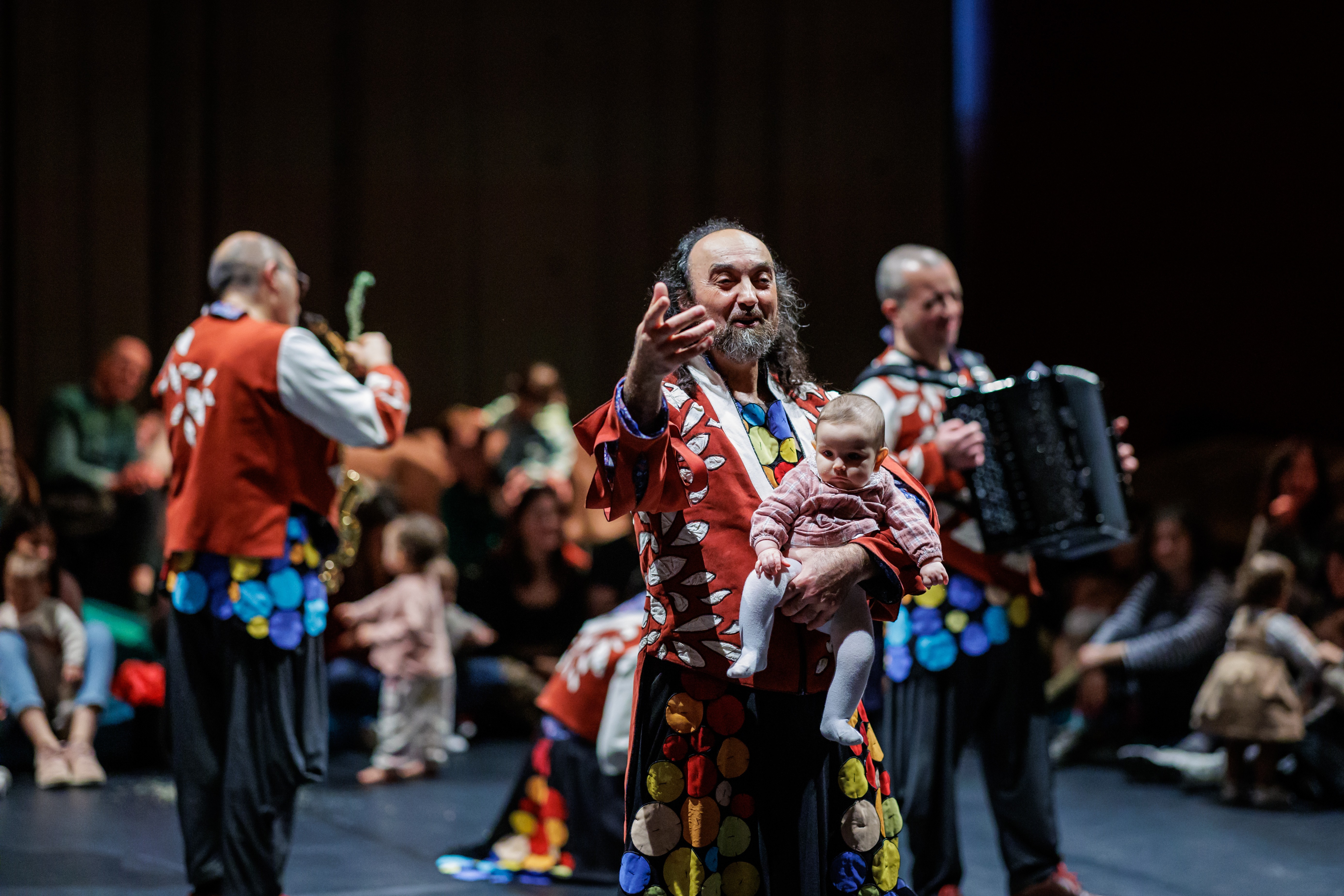
Paulo Lameiro, artistic director at Musicalmente © Casa da Música
Musicalmente
“There are no ‘babies’, there are Marias and Manéis,” Paulo Lameiro firmly replies whenever he is asked what the best music is for this age group. “It’s the same as asking ‘what’s the best music for people in their forties?’; everyone has their own preferences.”
A musicologist, educator and artistic director of the Musicalmente company, he has over 30 years’ experience in educational and artistic production projects for early childhood. In 1992, at the age of 18, after being rejected by the Lisbon Conservatory for “being too old compared to the other applicants”, he returned to his home village, Pousos, in Leiria, to design an arts education programme starting with babies, called Berço das Artes.
Building on these classes, in 1996 he set up ‘Músicos de Fraldas’, a training programme for professionals in the field of early childhood arts education, heavily influenced by the first visit to Portugal in 1995 of Edwin Gordon, a professor and researcher in music education. “I realised that working with babies was not only possible, but essential.”
The following year, he founded Concertos para Bebés which, as he often says, “are simply concerts”. Throughout the year, there are 11 programmes with a repertoire ranging from classical to jazz, from traditional Portuguese to world music, from electronic to alternative music, and including improvisations and dances. “Going to a concert is just as important for a baby as it is for an adult to go and see an exhibition or watch the sunset,” explains the musicologist. “They will enjoy that moment, they will feel something and discover things about themselves that only the exposure to art allows.”
For 10 years, Concertos para Bebés were held monthly at Casa da Música, where Paulo Lameiro often returns with Musicalmente for other sessions. On the 9th, he will present O Bebé Compositor there, a programme forming part of Amplify, a project conceived by a European consortium to enable babies to ‘compose’ with the help of AI. The babies will have sensors attached to their bodies that will read their reactions to the music and translate them into sheet music, transmitted in real time to the musicians via virtual reality headsets. There will also be cameras filming the parents or carers.
“The extent to which a baby engages is linked to the extent to which the parents engage,” notes Paulo. In this sense, whilst it is true that some music is better suited to capturing babies’ attention – Baroque music, for example, is composed in shorter movements than Romantic music – the best pieces and composers to play for babies are those that you enjoy the most. “Essentially, the baby responds to a good relationship with music.”
Música com Bebés & Papás
For Indy Paiva, working with young children was “a chance encounter that turned into a passion and the discovery of a true calling”. In 2011, he was invited by the programming director of the extinct Clube Literário do Porto – where he taught guitar – to lead a music workshop for children and families. He eagerly accepted the challenge, but not before attending the Músicos de Fraldas programme, run by Paulo Lameiro in Pousos, Leiria.
“I had become a father for the second time in August 2010, and my daughter was both an inspiration and a 'test subject' in the process,” he says. In late April, Música com Bebés & Papás kicked off, a trio project with Lipe Paiva (piano and other instruments) and Kate Rodrigues (vocals and percussion), in which Indy takes on narration, vocals, guitar and percussion.
Over the past 15 years, Indy & Trupe have run hundreds of music and musical expression sessions for babies and families. Typically, there is a monthly theme, from which stories are chosen that include “songs and soundscapes with tonal and rhythmic patterns”. Indy emphasises the collaborative nature of the shows. “We share ergonomic instruments adapted for babies and children with whom we make music.”
Making the most of music as a language in which “verbal expression is not always the most important thing”, Indy & Trupe focus primarily on aspects such as “learning songs, developing a range of vocal timbres and active listening” when preparing their sessions. Issues such as motor skills, lateral coordination and balance are also taken into account.
As part of Música com Bebés & Papás, a project that regularly tours various municipalities on the outskirts of Porto, events such as Música com Dragõezinhos have emerged, with monthly sessions at the FC Porto Museum (on the 3rd, they’ll be there with the theme “Mum”). From time to time, Indy & Trupe perform at nurseries, schools, associations and local councils from north to south of the country.
O Som do Algodão
Words and music go together in O Som do Algodão, a project by Dulce Moreira and Mariana Santos which, since 2012, has been putting on shows and workshops for young children. They began by creating stories for children and, in 2016, immersed themselves in the world of babies with the Aves trilogy (Ovo, Ninho, Voar), crafting soundscapes and literary landscapes with a variety of rhythmic and timbral textures.
“Babies require a wide variety of stimuli, so we try to make our creations as versatile as possible,” says Dulce, a musician and the author of the duo’s original songs. The words are provided by Mariana, an actress who is responsible for the dramaturgy, oral narration and theatrical performance of the shows.
For the duo, designing shows for babies necessarily involves including their carers. “They’re not just there to look after the babies; we want them to participate actively.” To achieve this, they draw on musical and sonic references from a particular generation to trigger a “sense of identity.”
Often, the experience is shared by the immediate family unit – that is, parents, baby and an older sibling – which generates a multitude of interactions. “The older children are already following the story,” says Mariana. “Sometimes they come over to us to ask about the songs and we say: ‘Go and ask your dad if he knows it!’”
Over time, O Som do Algodão has built up a loyal following across the country. “The other day, a mother came with her baby and her 11-year-old daughter, whom she’d already taken to a show when she was a baby,” recalls the actress. “It’s lovely to see families growing with us.”
Alongside the shows, the group runs an art project for babies at the Guli Family Club, incorporating visual arts, movement, theatre and music. Still in an ‘experimental phase’, the workshop aims to introduce children to various forms of artistic expression over a two-month period, though it can also be attended on a drop-in basis.
Dulce and Mariana hope that the shows and workshops are just the start of an ongoing artistic experience for the whole family. “Whether it’s singing the songs or talking about what they’ve experienced, the idea is that they can then take this home with them.
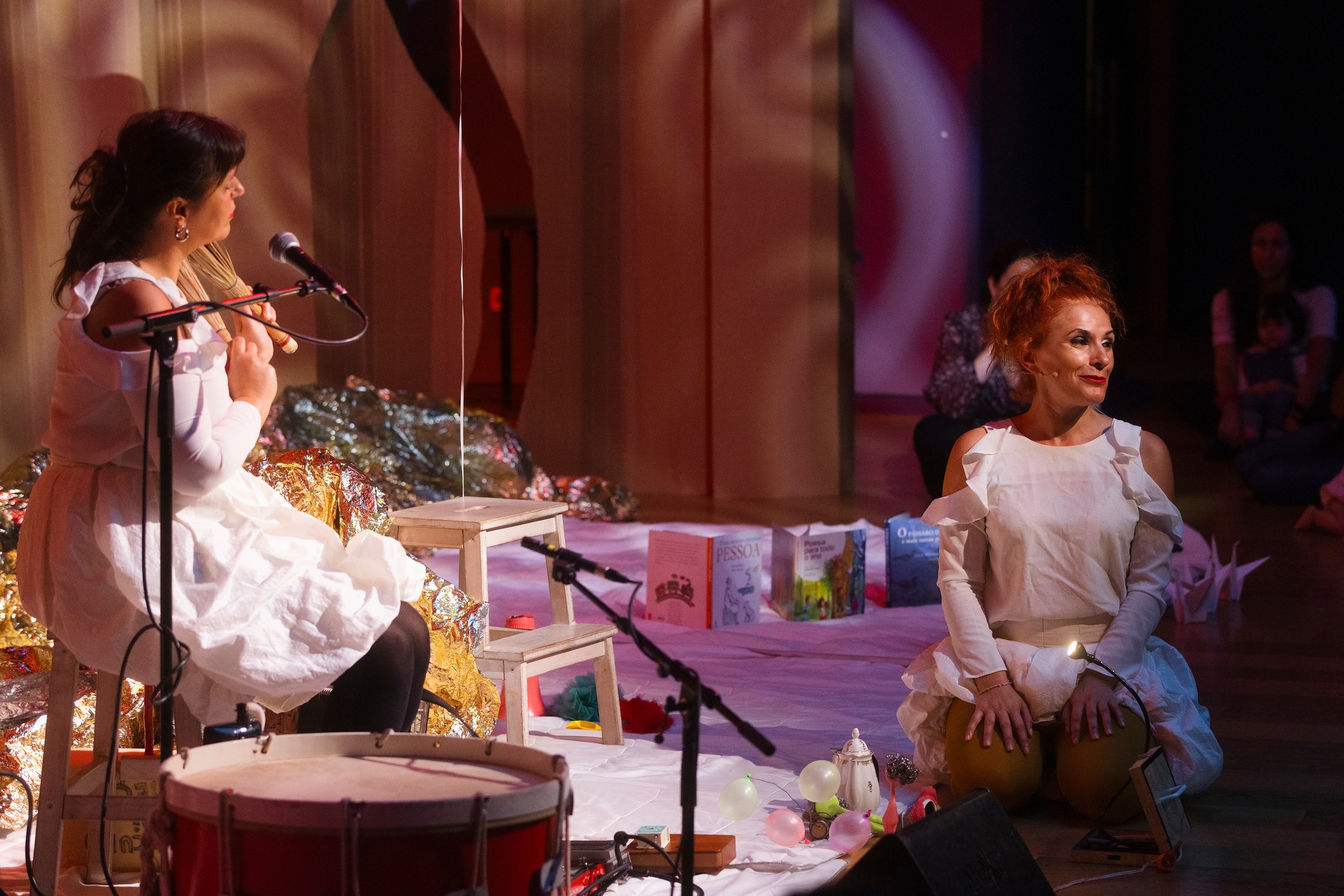
Dulce Moreira and Mariana Santos © Lara Jacinto / Coliseu do Porto
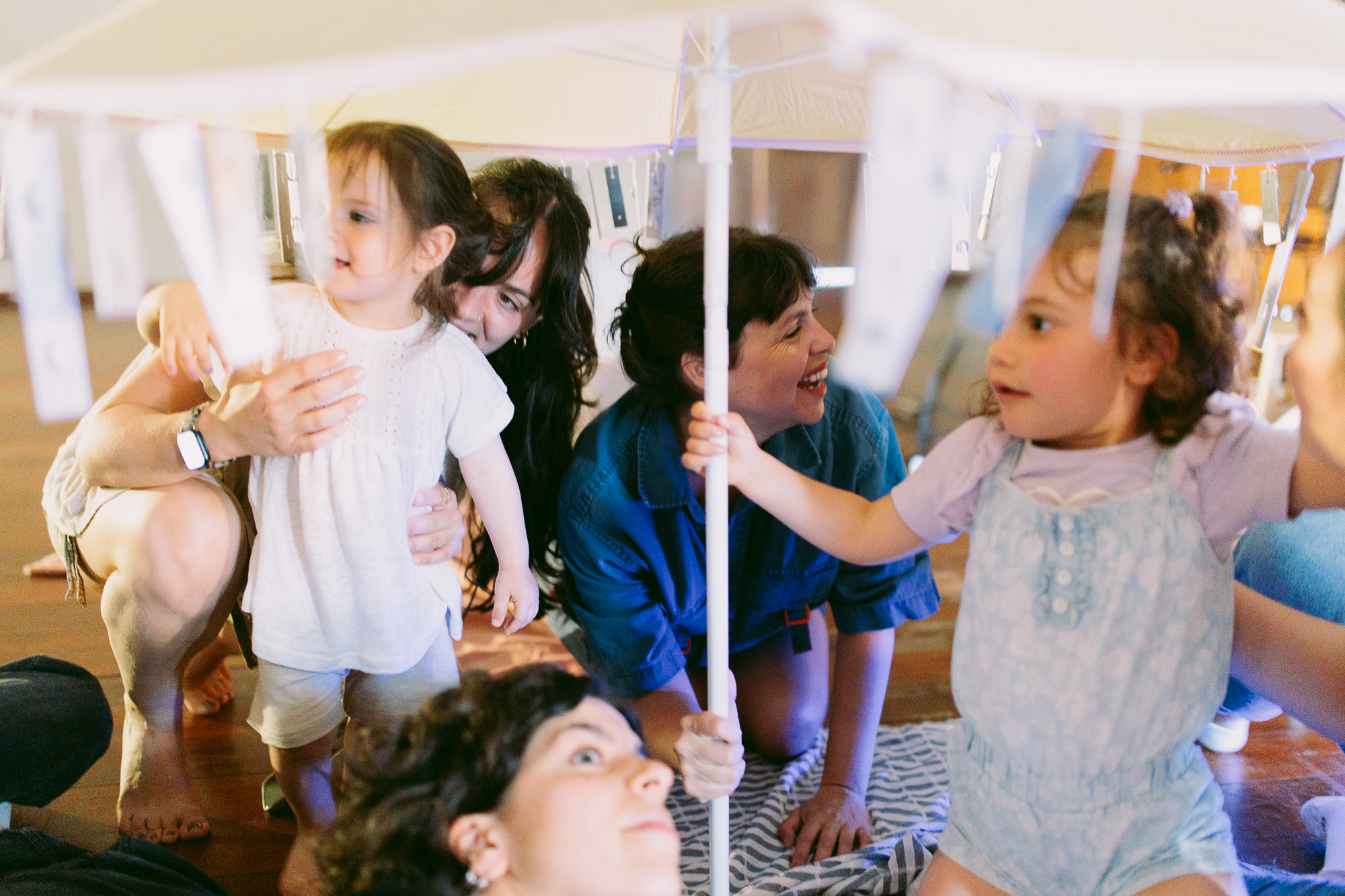
Há Um Rio Nesta Gota, a show by Frenesim © Renato Cruz Santos
Frenesim
Founded by a group of artist-educators, Frenesim began as “a cultural mediation service that started with babies and ended with grandparents”. In the early days, they ran art workshops whilst exploring “how to work with each age group”. “We developed a working methodology based on the many sessions we held with families,” explains Rita Campos Costa.
First comes ‘start by starting’, a moment that involves those who arrive early without excluding those who are late. This is followed by ‘a welcome, a rhythmic pattern, something to get people moving, something to sing, an ostinato [a phrase or motif repeated throughout a piece of music], a strange collective instrument, and a song to see people off’.
“Children thrive on routines,” emphasises the project’s artistic and educational coordinator. “There’s a sense of anticipation where they think: ‘Oh, she’s going to do that again!’” The staging is also designed to serve these creations, which are a combination of a show and a workshop – musicians and families form two crescent shapes facing each other.
The sound of Frenesim’s activities draws on the musical experiences of Zé Figueiredo (a member of peixe:avião with links to rock and electronic music) and Rita Campos Costa (a member of Sopa de Pedra, an all-female traditional music ensemble), and is reflected in adapted or original compositions. “There’s no such thing as ‘cute’ music for babies,” says Rita. “There is music, and whether it is relevant or not depends on the narrative and context we have.”
Families are invited to help create the ‘layers of sound’ for the workshop-performances by recording their voices with the help of the team, who use only unconventional instruments – that is, ‘things that make sound’ that they have made themselves.
There is also a significant artistic dimension. One example of this is the show Há Um Rio Nesta Gota, which will be performed at the Almeida Garrett Library on May 3rd at 10.30 am. There are handkerchiefs that serve as boats, paintbrushes that act as oars and, at the end, an open river made from a large roll of kraft paper, where the babies paint with water. “Parents are surprised that they stay there for so long,” reveals Rita. “You don’t need to do much; you need to do less, because children are overstimulated.”
Espaço Aurora
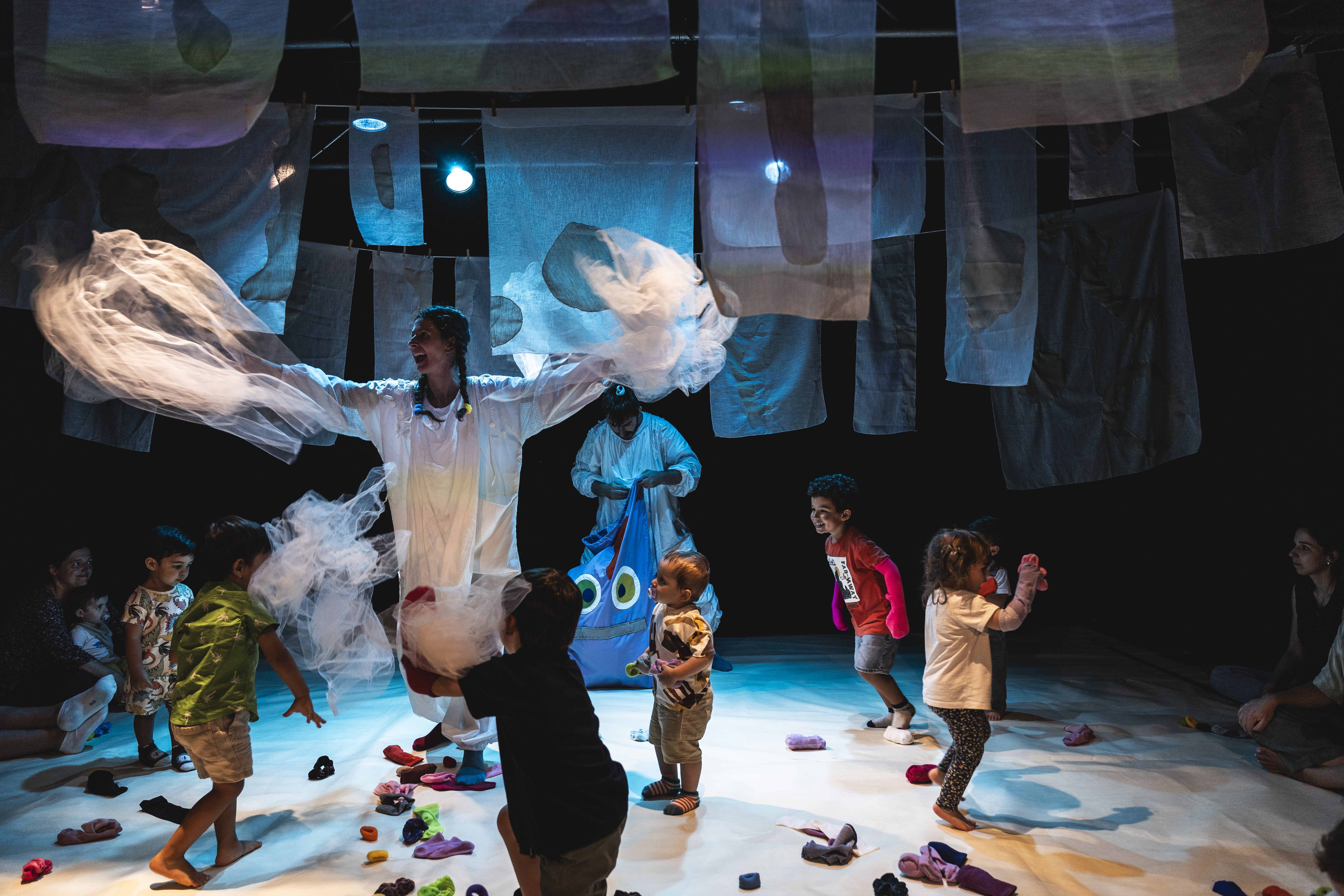
A performance by Bebé em Cena © Jorge Costa / Cultura em Expansão
‘Observe, ‘feel’ and ‘experience’ are verbs that Susana Brandão puts into practice every day at Espaço Aurora, which she opened in 2020 and named after her mother. With a degree in Architecture and describing herself as an incorrigibly curious person, she studied aerobics, fashion and theatre, and has never strayed far from the latter. After putting away her architectural models, she taught drama to children and young people and wondered about the creative block many faced. “I realised it had to do with their earliest experiences linked to their creative and sensory sides,” she recalls.
It was with the aim of working on these elements during the early years of life that Aurora was conceived, based on three pillars: Aurora Casa, a physical space that welcomes children every day for a variety of experiences, including artistic ones; Aurora Semente, a mobile unit that visits schools and runs activities tailored to each one; and Aurora Palco, an early childhood theatre project co-created with the Brazilian artist and educator Thiago Franco.
Titled Bebé em Cena, the project draws on a contemporary artist or work and research carried out with the children who attend Aurora to construct the narrative of workshop-performances. “It starts off more like a play, but then the children come on stage with us and stay for as long as they like,” she explains.
Although incorporated in an unconventional way, music permeates the three areas of Aurora. At Casa, it features in the curated selection of songs that accompany the experiences, in practical activities to work on rhythm with the body or to handle instruments, and in sound awareness sessions, which involve musical experimentation with materials that are not instruments, such as wood or metal.
At Semente, there isn’t a musical activity per se, but sound is integrated into the activities on offer, notably through a curated playlist designed to “set the mood, liven things up a bit or calm things down a little”, respectively. At Palco, however, original songs and those by other artists are played using instruments made from everyday objects, which the babies can also explore. “We have one made entirely from coffee capsules, from the [show] Estado de Pássaro, which makes an incredible sound.”
Every day, Susana Brandão sees evidence of the importance of music in early childhood. “Most children respond to this art form,” she emphasises. “If you give them paints, they’ll watch at first and don’t always get straight into it, but they really engage with sound.”
Regularly touring various towns, Aurora will be performing at home on May 23rd at 10.30 am with the show Liberdade das Cores at the Guli Family Club.
Música com a Eva
Eva Nascimento heard her first songs while still in her mother’s womb. Later, she began humming them to her sister, who was born when she was 11. It was with her that she tried out games, playtime activities and stories, and realised that she wanted to work with young children for the long term. “I became a teacher to work with primary school children, but then I discovered that my passion was actually babies,” she recaps.
In 2006, she began focusing on music for babies, joining projects led by other creative professionals who had a more formal background and approach to this art form. Her desire to put her own personal touch on these activities led her to set up Música com a Eva four years ago. “My aim is to use music as a tool for babies’ cognitive, motor, emotional and, above all, social development,” she explains.
Eva usually begins the sessions with the help of a stuffed owl, which acts “as a channel of communication with the babies”. Afterwards, babies and families are invited to take part in a shared musical experience, marked by moments of calm, joy, mystery and surprise. The activities are based on “a book, an event or a game” and may also include stories made up by Eva, such as the one about the “big, mean bird that wouldn’t let the other birds fly higher than him”, alluding to the Carnation Revolution.
Traditional Portuguese songs, as well as world music, feature regularly in the sessions. There is also a significant focus on movement and sensory exploration, as babies are encouraged to move around the room and handle the instruments and other objects.
Currently, Música com a Eva runs sessions in venues such as PlayLab Porto – the next one, titled A minha Mãe é uma floresta, takes place on the 10th at 10.00 am – as well as in nurseries, pre-schools and at birthday parties. “There is an increasing need for parents and children to have the time and space to be together and strengthen their bonds without distractions.”
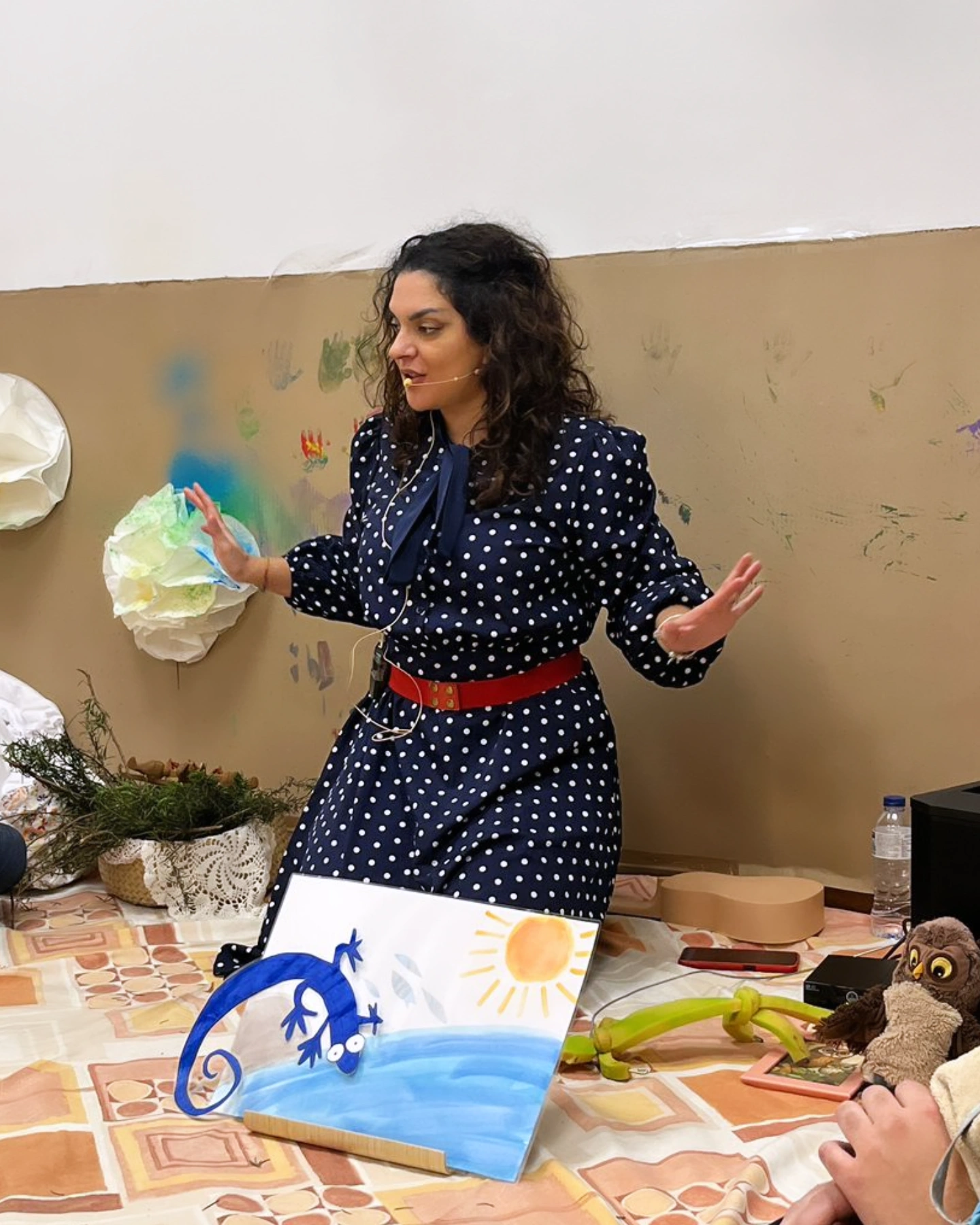
© Música com a Eva
Share
FB
X
WA
LINK
![[Bibliotecas do Porto] - ESPETÁCULOS PARA FAMÍLIAS — HÁ UM RIO NESTA GOTA](https://img.bndlyr.com/slgso3uvbp8d6xgm/_assets/cred_renato-cruz-santos_cee_frenesim-4515.jpg?fit=fill&w=800)
