

EN

March 2026
For Magda Cruz, the city of Porto is an open book that she began leafing through about six months ago. This communicator, cultural promoter and podcaster recently moved to Porto to work at Livraria Lello. With a degree in journalism, she has worked in the newsrooms of TSF, Rádio Observador and the Público newspaper, and is the author of Ponto Final, Parágrafo, a podcast dedicated to books. In this project, she conducts literary interviews with authors, but also with book lovers. The new season kicks off in March, the month that marks National Public Library Network Day (11) and International Storytelling Day (20).
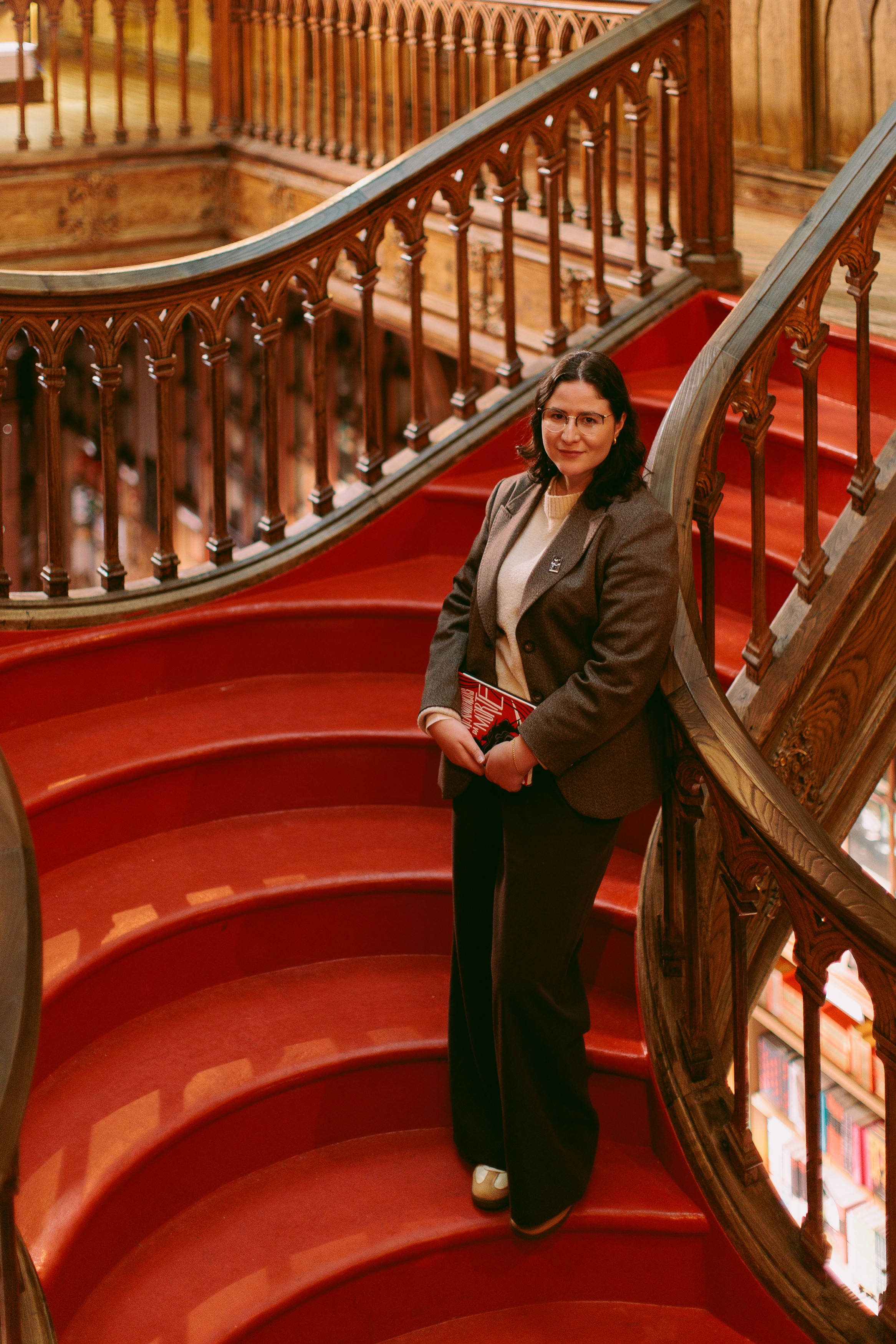
Magda Cruz © Renato Cruz Santos
Since January, she has also been the voice behind Palavrão, an original podcast from Livraria Lello. A regular visitor to Estádio do Dragão (she has been a Porto fan since she was a child) and the Almeida Garrett Municipal Library, last month she launched Crónica de uma lisboeta a viver no Porto (Chronicle of a Lisbon native living in Porto), with a new episode released every Sunday. In her first published text, she wrote that ‘pronunciation is her denunciation,’ but we thought Magda already rolls her Rs like the people of the North. It was on the crimson stairs of Lello that we sat down to chat, starting with the theme of leafing through pages.
‘The ambiguity in words interests me a lot. To leaf through is to turn the page, to change. It is also to read, whether a book from cover to cover or jumping between chapters, it is to read the landscape and the language of people. To leaf through the city is to discover and explore new chapters,’ she says.
There is no doubt about it: Magda is happy surrounded by books. She says she ‘was always lucky’ that her parents took her and her siblings to the library, and as she grew up, libraries never ceased to be part of her life. Every Saturday, ‘at least’, she would take a trip there to ‘borrow as many books as she could carry’.
There is no doubt about it: Magda is happy surrounded by books. She says she was ‘always lucky’ that her parents took her and her siblings to the library, and as she grew up, libraries never ceased to be a part of her life. Every Saturday, ‘at least’, she would take a trip there to ‘borrow as many books as she could carry’. Before she could buy books, she would go to the library. That's why, she says, ‘it makes perfect sense’ that the 8th season of Ponto Final, Parágrafo should be recorded in Porto's municipal libraries, including the mobile ones. ‘The area of the city where I chose to live has a small library, Pedro Ivo, in Praça do Marquês, which will also be one of the venues for the conversations,’ he says, adding that ‘most of the guests are from Porto and the North.’ ‘The focus will be on authors of various genres, always with a special emphasis on parity and variety of voices and backgrounds,’ she says.
Ponto Final, Parágrafo Reading Club
Linked to Ponto Final, Parágrafo, created on 8 October 2018, the 20th anniversary of the announcement of José Saramago's Nobel Prize for Literature, in 2021, a reading club that now has around 150 members who meet on the last Saturday of each month at 9 p.m. to discuss a literary work. “Who wants to read Saramago's works for 12 months?” was the tweet that gave rise to this community of readers. ‘I invited people to read or share Saramago; the idea was to read 12 books, but we ended up reading 14, and the club grew,’ she says. "I think the start was one of the best times because we had participants or readers from various countries, all united by Saramago.
Having started during the pandemic, the club was online, and Magda kept it that way ‘because there are people who say they appreciate it being online so they can connect from a distance.’ And, as in all clubs, there are rules; in this one, there are only two: ‘people have to be in their pyjamas or comfortable tracksuits, and anyone who has pets has to introduce them at the beginning of the session,’ she laughs.
This year, the theme of the reading club is dystopias. ‘Writers write fiction, but fiction is becoming increasingly similar to reality, and I thought it was important that those who had not yet read the dystopian canon should have that opportunity.’ In January, George Orwell's 1984 was read, in February, Anthony Burgess's A Clockwork Orange, and this month João Reis' Cadernos da Água will be read. ‘There are more Portuguese authors on this list; throughout the year, works by Joana Bértholo, Filipa Fonseca Silva and Mafalda Santos, among others, will be read.’

1984, de George Orwell, um dos livros lidos no Clube de Leitura do Ponto Final, Parágrafo © DR
The culture promoter says that ‘it allows people to participate however they want’: ‘they can send their reviews in writing, participate via speakerphone, or join the online discussion and just listen.’ ‘We share different views, and sometimes the book I read is different for you, even though it has the same title, and that's what makes it enriching,’ she emphasises, stressing that, although it is sometimes difficult to run the club because she has so many other things to do, ‘at each meeting, people remind her why she started it.’
"At the last meeting, a young man participated for the first time and told me that he had read 1984 and realised that Winston's [character] power was political and social memory; that he went to Christmas dinner with his grandmother and realised how important she was to him. So he said goodbye and is now writing a book about memory. He even applied for the DGLAB creation grant!‘, she says. In this sense, she believes that the reading club has ’an influence on people, and this movement tends to repeat itself in the sessions; someone whose life has changed a little, even if only because they stayed at home reading over the weekend."
This year, the reading club is themed, but Magda assures us that the great value of this community of readers lies in the fact that, at the end of each session, ‘the group chooses what to read next, reflecting on what is happening in the world, what books have been published in the meantime, and what discussions need to be had, and decides democratically’ which books will be read.
Although it is an online community of readers, Magda has already organised a face-to-face session and says that this year she wants to repeat it in the city of Porto on a date that coincides with the Book Fair. ‘That way, there are more reasons for people to come here.’ Anyone who wants to join can simply join the WhatsApp group via the Instagram account of the Ponto Final, Parágrafo project.
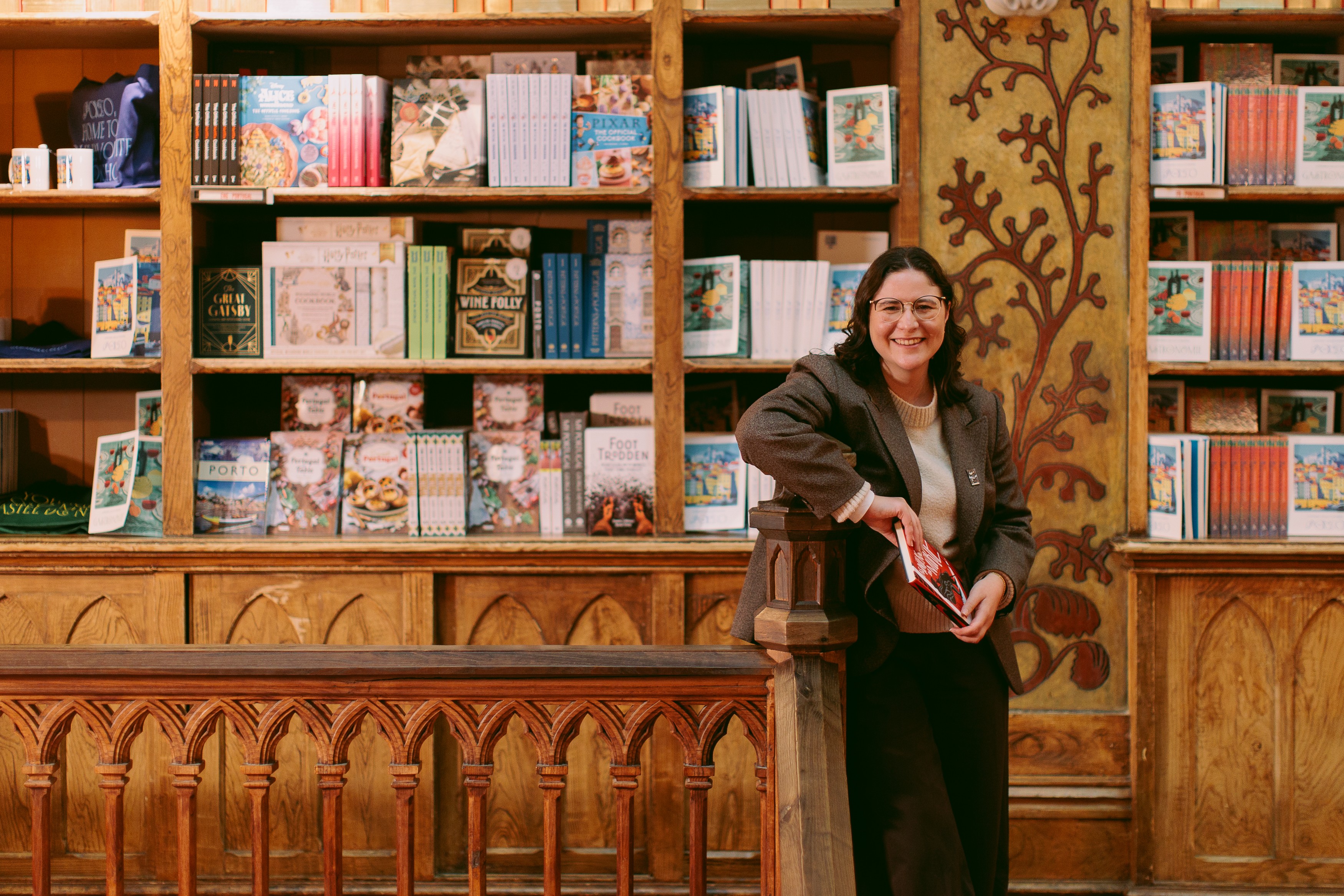
“Ler e falar de livros dá-me sanidade mental”, Magda Cruz © Renato Cruz Santos
Chronicle of a Lisbon native living in Porto and her love for FCP
It was in February that Magda launched Chronicle of a Lisbon native living in Porto, and she wanted to start with ‘an almost diary-like record’: ‘to protect this literary genre, which I feel is disappearing, but also like the 10-year-old Magda who kept her diary, and I thought it might be important for someone my age to record her first big change — coming to live alone for the first time in another city,’ she says.
The first six months of living in Porto ‘have been condensed into the verb “to leaf through”’. The choice of ‘leaf through’ for this section of Agenda Porto, she assures us, ‘was not random, there was a lot of intimacy behind it’. ‘I have been able to leaf through Porto as if reading a book,’ she declares. “When I arrived here, I was introduced to the concept of the ‘15-minute city’, and it’s really true. From Livraria Lello, I can be at my house in 15 minutes; from my house, I can be at Estádio do Dragão in 15 minutes; from Estádio do Dragão, I can be in Bonfim in 15 minutes, where I go to drink a fino and eat a francesinha.”
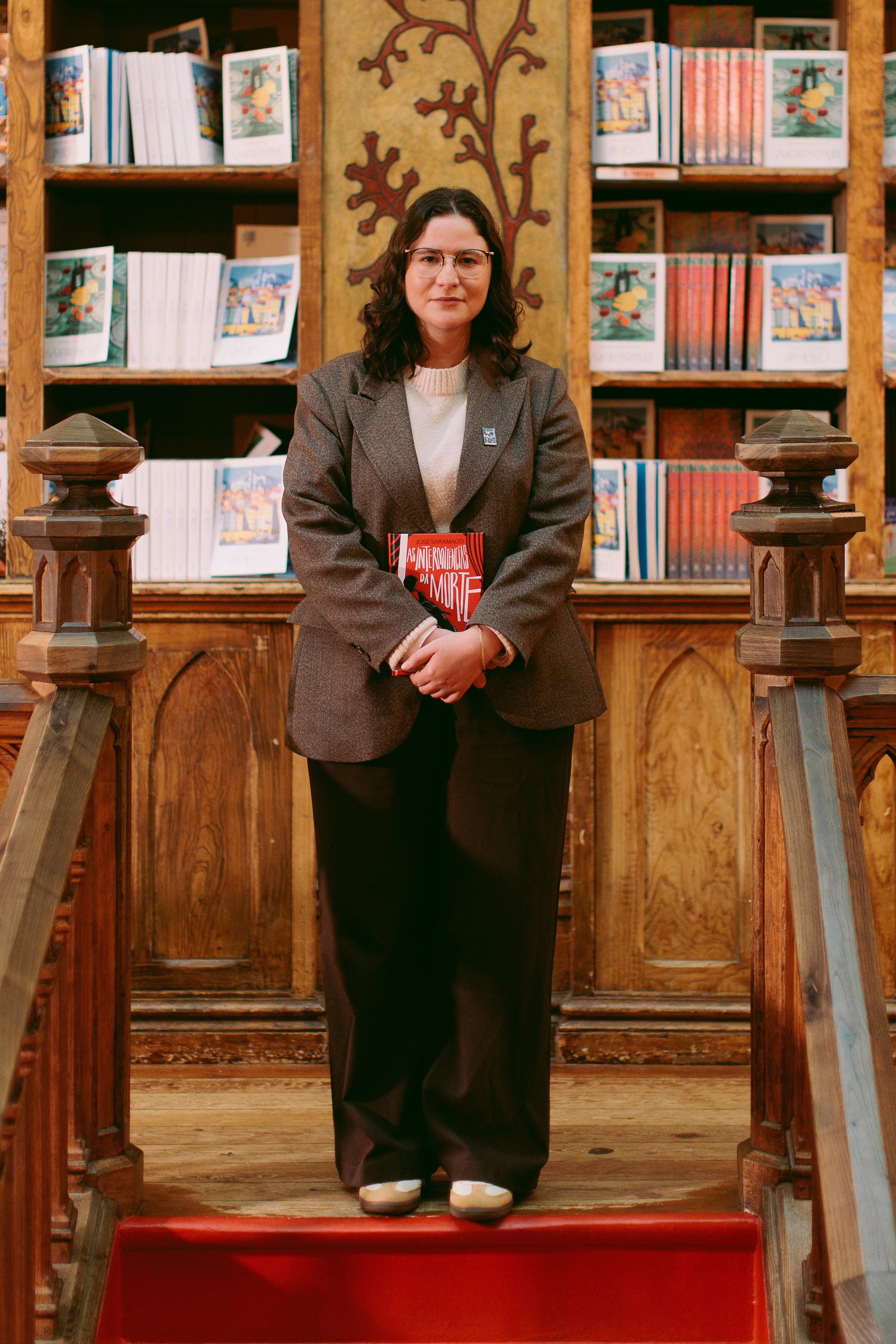
© Renato Cruz Santos
‘In Porto, cultural life is becoming more accessible to me.’
Magda says that cultural life in Porto is ‘more accessible’ to her, and scale is also important in this regard. ‘I feel that my colleagues have more time to experience Porto than I had to experience Lisbon; therefore, it is easier for me to leave work and go explore the city,’ she says. ‘I can get to various [cultural] offerings more quickly and I don't have to spend an hour and a half getting to the theatre, the cinema, or an exhibition.’ The communicator also notes that ‘here, culture is more immediate, more open and more accessible’ and, in this sense, points to TRIPASS as an example, a card promoted by the Porto City Council that gives 25% discount on cinema tickets in the city centre, adding that ‘nightclubs are cheaper’.
When asked about her favourite places in the city, where she often returns, she readily says that ‘you have to start’ with the Estádio do Dragão. "Before I arrived in the city, I already frequented the Dragão because I've always been a Porto fan. I was lucky to be a Lisbon native with good taste (laughs). And I had a very happy childhood because Porto always won when I was little, so it was easy to be the only Porto fan in a class full of Sporting and Benfica fans (laughs).” Magda also confesses that one of the walls in her bedroom in Lisbon is covered with images of the Estádio do Dragão. “It has always been an intense love. The truth is that since I arrived in Porto, FCP hasn't lost a game. So, I don't know if I'm some kind of lucky charm (laughs).”
‘Swear words here are terms of endearment. People insult each other affectionately.’
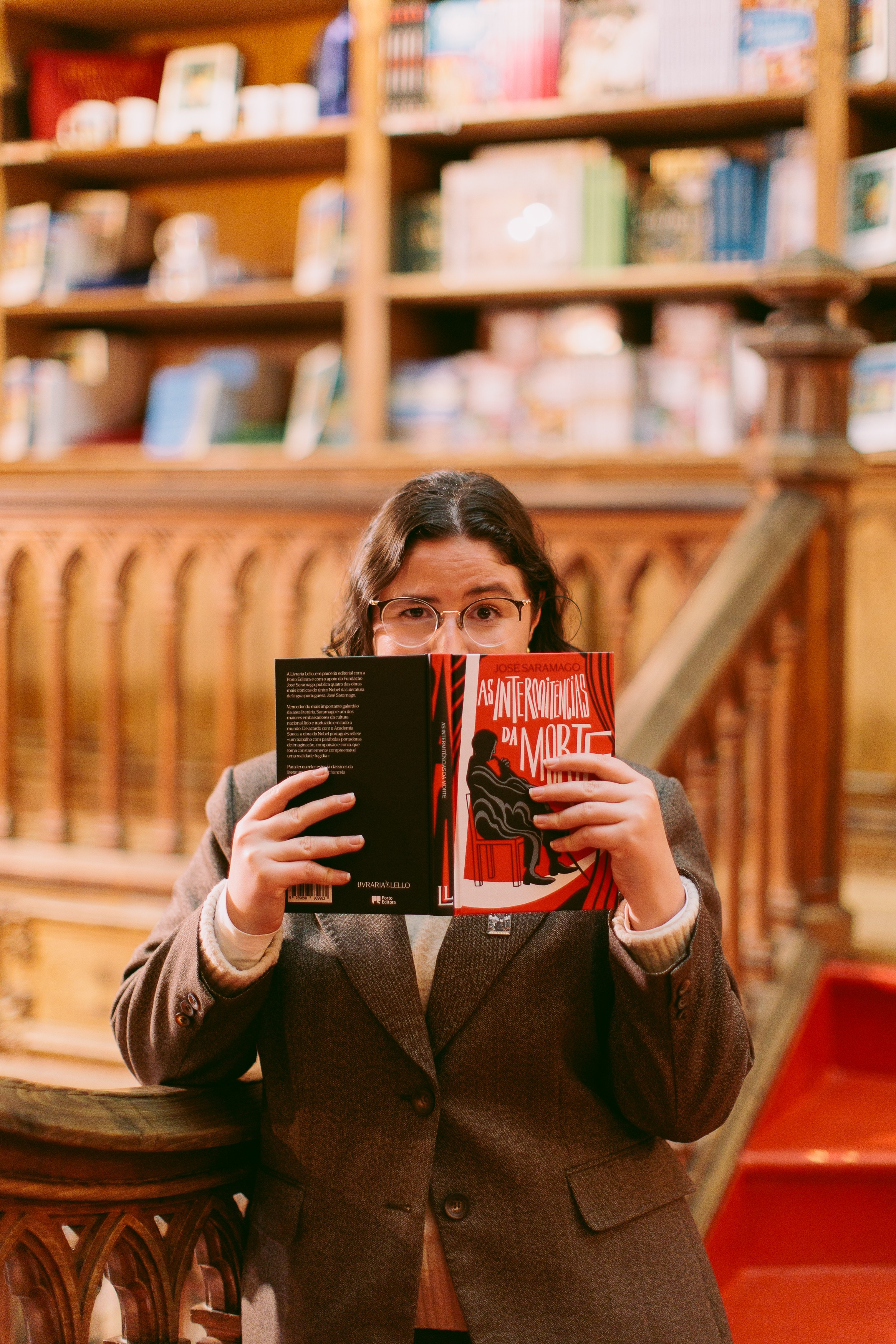
© Renato Cruz Santos
But, as we know, Magda doesn't live by football alone. There are also books. And the first place that gave her ‘shelter’ in the city was the Almeida Garrett Municipal Library, because her arrival coincided with the last weekend of the Porto Book Fair. "I spent Saturday and Sunday there, and Sérgio Godinho closed the Book Fair by saying: “Tonight is for everyone; whether you were born in Porto, came to visit the Book Fair, or have just arrived to live here”. And I thought: “He's talking to me! He just welcomed me!", she recalls, smiling.
The communications expert says she is ‘happy’ to be living in Porto, and ‘above all, to have been adopted by the people who live here.’ She adds: ‘You know what? I feel like I'm funnier here; I think I'm funnier.’
‘I've always been a bit of a clown, and anyone who follows the podcasts knows that, and I notice that this “salt and pepper” humour in my writing has become more refined.’ And it is with humour that Magda hosts Palavrão, the Livraria Lello podcast, where she invites personalities from different fields to deconstruct the ‘bad words’ related to their professions. There is a new one to listen to every week.
When asked what books she has been reading, the avid reader tells us that, in addition to the books from her book club, she is currently reading O Lugar da Incerteza (The Place of Uncertainty) by Patrícia Reis, which will be presented at Livraria Lello; O Fim dos Estados Unidos da América (The End of the United States of America), by Gonçalo M. Tavares; Herland – A Terra de Mulheres (Herland – The Land of Women), by Charlotte Perkins Gilman; and Filho do Pai (Son of the Father), the latest book by Hugo Gonçalves, her ‘favourite living author’. ‘He is hilarious and super elegant at the same time.’
Magda also reveals that she ‘always has a book of poetry on the go’. " And I always have Manuel António Pina and Sophia de Mello Breyner, poets from Porto, to hand,‘ she reveals, adding happily that she “discovered” the Modo de Ler bookshop, where she bought works by Eugénio de Andrade edited by José da Cruz Santos, the ’prodigious creator of books" whom Agenda Porto interviewed in its inaugural issue in January 2024.
Share
Relacionados
