

EN

July/August 2026
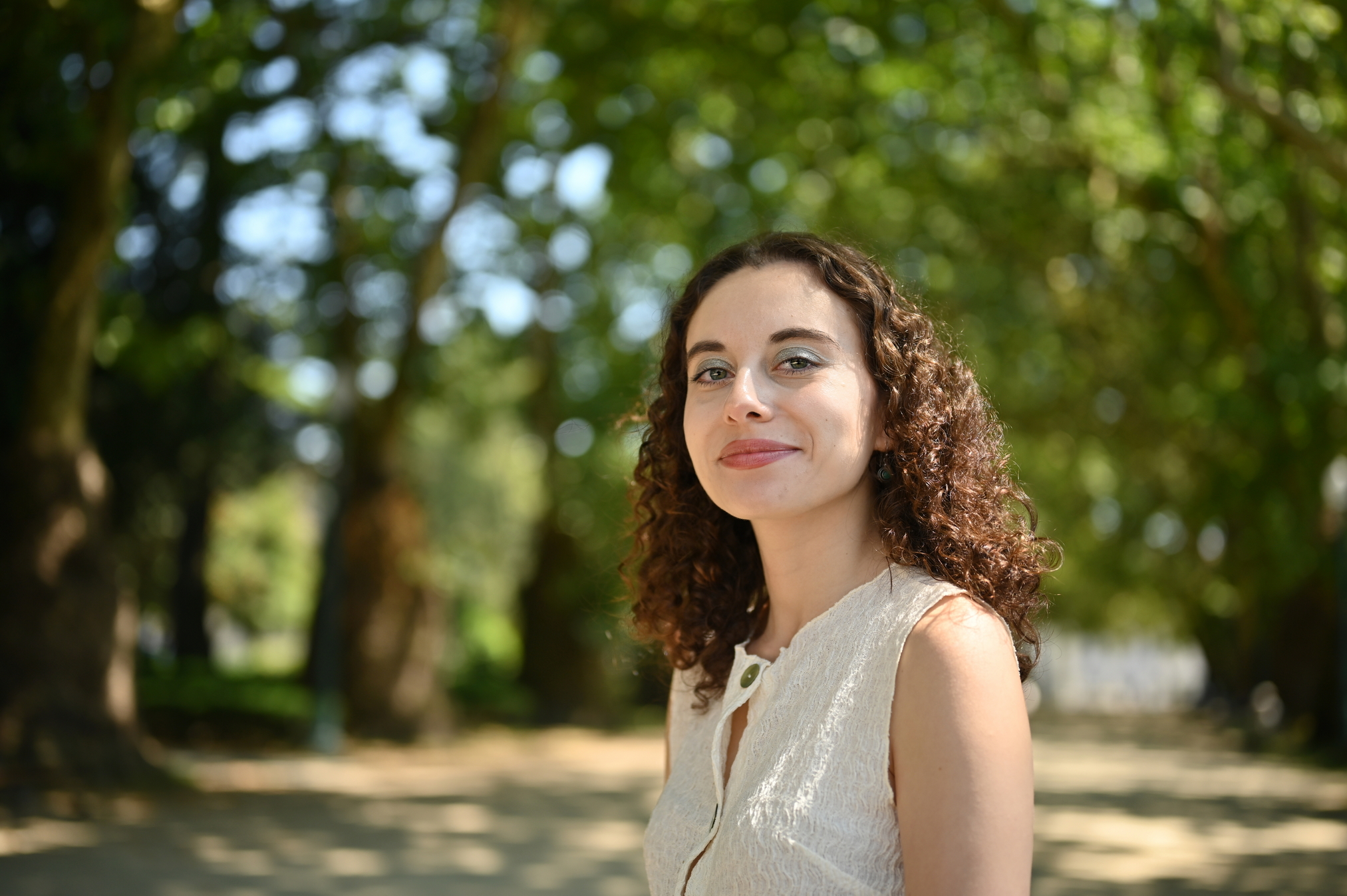
Daniela Fatela Geraldes had never seen a blind person in a museum before. This realisation, followed by a flood of questions, came about during a volunteering experience at ACAPO – the Association of the Blind and Visually Impaired of Portugal. “I began to realise that these people did not go to museums because, very often, they lacked accessibility resources,”“ explains the researcher from the Research Institute in Art, Design and Society – i2ADS, at the Faculty of Fine Arts of the University of Porto (FBAUP).
Having graduated with a degree in Sound and Image, it was whilst studying for her Master’s degree in Art History, Heritage and Visual Culture that she first became interested in Art Education – a field of study she would go on to specialise in during her PhD at the FBAUP – and in the work of museum education departments. “I helped curate two exhibitions, one of them at the Soares dos Reis National Museum (MNSR), and saw how an exhibition was put together and how the museum engaged with the community,” she recalls.
Her first experience with the activities of the MNSR’s educational department, and the limitations in accessibility and inclusion she encountered, made Daniela realise that there was work to be done in engaging with audiences with specific needs, whether physical, sensory or intellectual. Her own experience as a neurodivergent person made her acutely aware of the urgent need to address these gaps. She therefore decided to develop her PhD project in collaboration with the MNSR, transforming paintings into tactile images so that blind and partially sighted people can experience works of art.
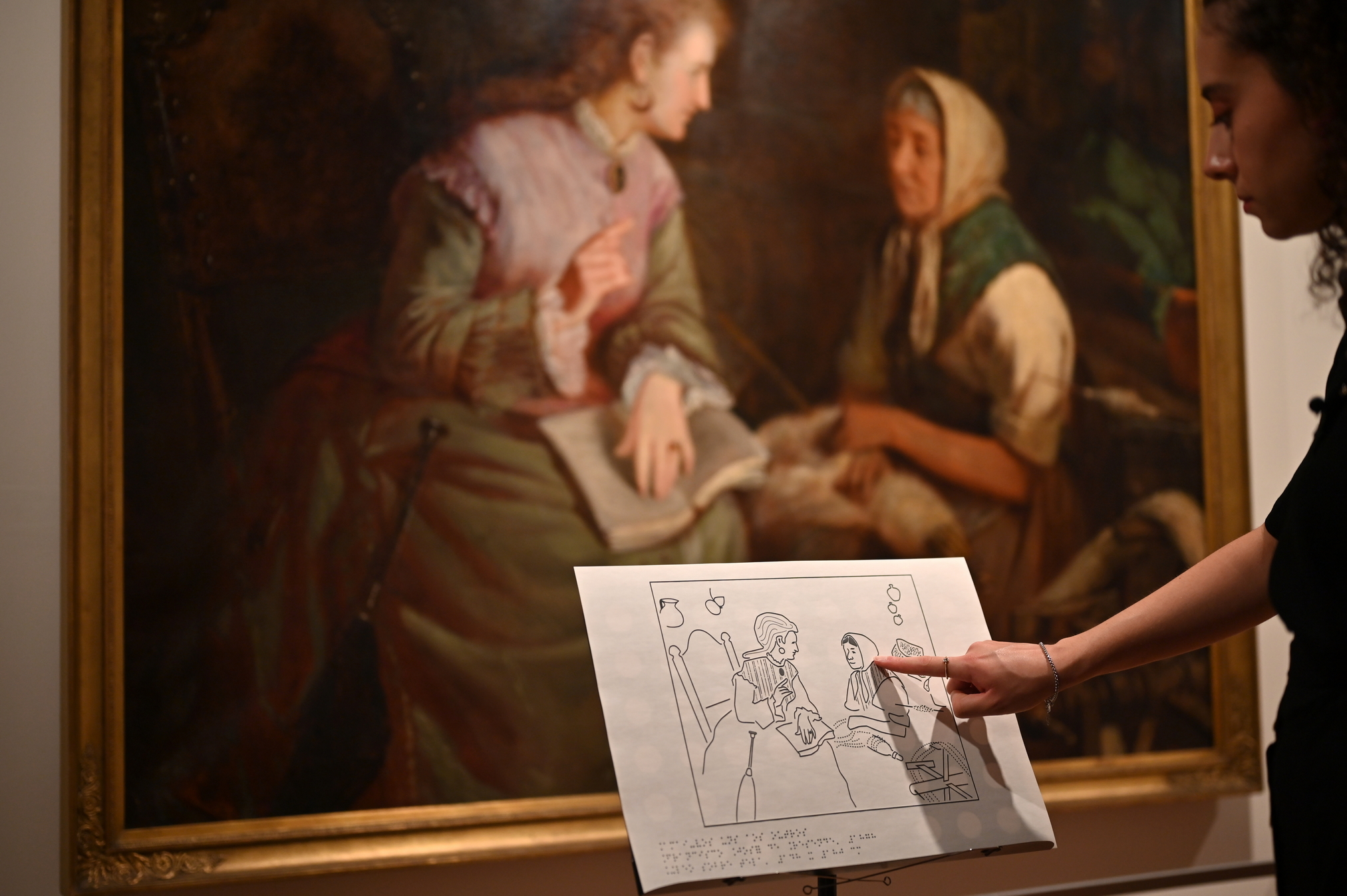
With the support of Ana Paula Machado, manager of the painting collection, and museologist Liliana Aguiar, Daniela selected a collection of the museum’s most iconic paintings, “some by artists from Porto which also tell the story of the Porto School of Fine Arts”, to send to Sertec, a Lisbon-based company specialising in creating solutions for blind and partially sighted people, which has previously worked with other Portuguese museums. She then gave them instructions on the aspects to highlight in each painting, which would correspond to different types of embossing. “If I want to highlight a particular tree, I can create a different embossed effect so that, when the person feels the image, they realise there is something there that perhaps has a special meaning.”
The images were produced on microcapsule paper, a material used to print graphics, maps and images for people who are blind or have low vision, but they are intended solely for testing purposes. “To be displayed, they would need to be made of PVC [a type of plastic widely used in visual accessibility tools], a material that does not tear easily when touched.”
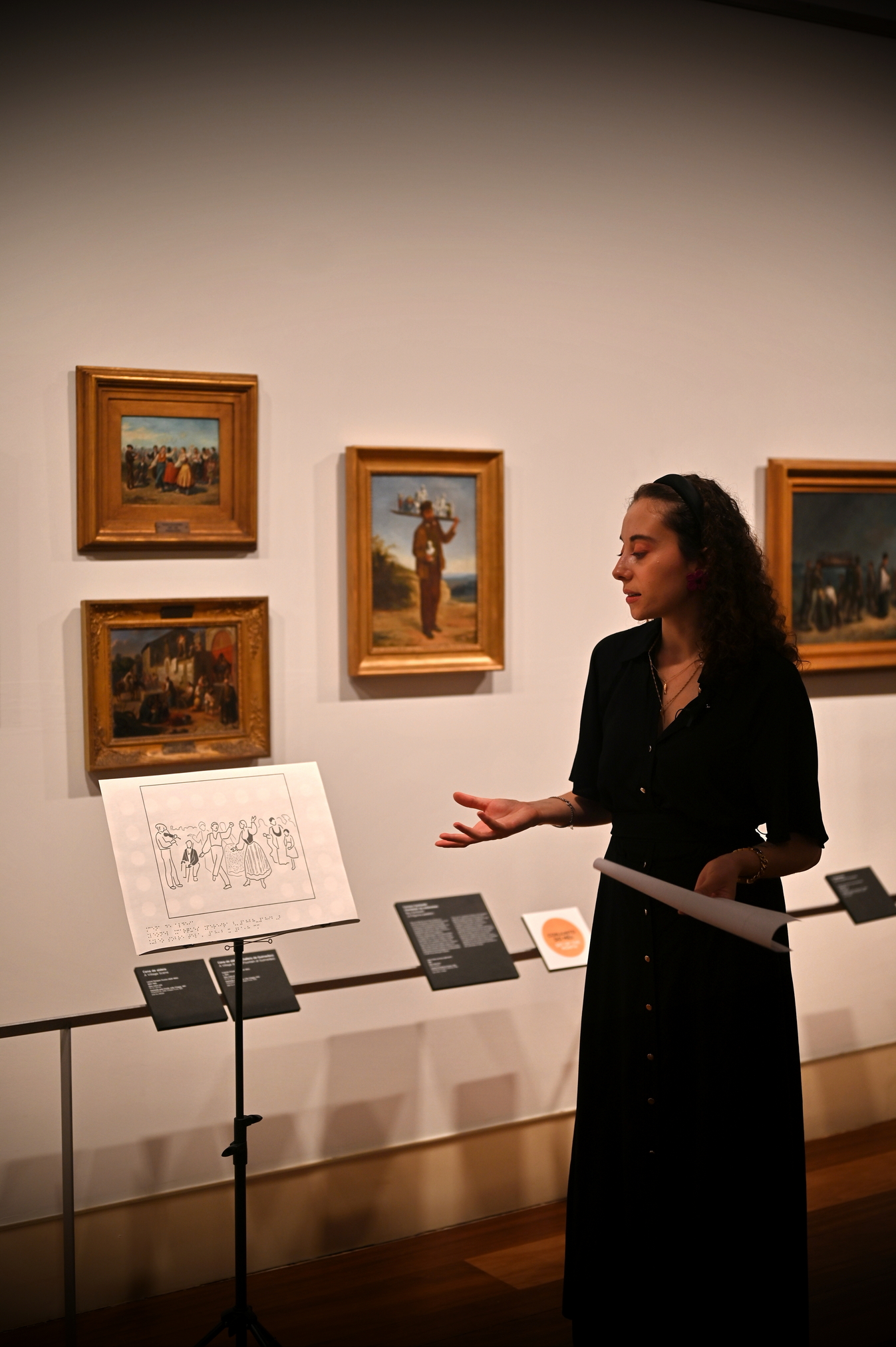
The trial sessions, scheduled for 20 and 27 July, will focus on three adapted works and are expected to involve around five participants (excluding accompanying persons). Each tactile image will be placed on a movable platform next to the corresponding original painting, so that participants can feel it whilst standing or sitting.
Participants may choose whether or not to feel the image. At the same time, the researcher will read the audio description of the artwork slowly, “pausing to check whether people are able to follow along and if they have any questions or queries”. In the course of her research, Daniela realised the importance of combining the two resources. “Not all blind people are able to read embossed images, and some prefer audio description,” she argues. Many do not want conventional audio description, “but someone beside them describing what they see”.
Last April, the MNSR board announced that it is developing a project to make the premises fully accessible from 2027, removing physical, sensory and communication barriers. Through the aforementioned project, the institution will establish a framework for designing and implementing permanent accessibility measures for blind and partially sighted people.
“The visual arts can also be appreciated through the other senses.”
Daniela Fatela Geraldes hopes that her PhD thesis will also help pave the way for an alternative concept of museums, shifting the focus away from aesthetic enjoyment. “The visual arts can also be appreciated through the other senses,” she observes, citing as examples the Fundación ONCE Typhlological Museum in Spain and the Centro de Experiência Viva – Typhlology Museum in Castelo de Vide, which are “much more sensorial museums, designed for people with specific needs [in the area of visual impairment]”.
She believes that issues of accessibility and inclusion should be considered and addressed in partnership with their future users, in order to “understand their real needs” and incorporate appropriate solutions. Museums’ communication must also not be overlooked as tools for accessibility, warns Daniela. “There are many people who think that a museum is not a place for them, either because they don’t understand what’s on display, or because they feel they aren’t properly dressed,” she explains. For the researcher, institutions must challenge the notion that they are sacred spaces reserved for the elite. “And if people do not go to the museum, the museum must go out into the community to showcase its collections and explain their importance to the city.”
As part of her PhD programme, Daniela also examined accessibility at various Portuguese museums, including some in Porto. Overall, she found that “there is goodwill on the part of both individuals and institutions”, but “sometimes there is little understanding of what accessibility is and who stands to benefit from it”. “It’s not just blind, deaf or disabled people; it’s all of us,” she emphasises.
In her analysis, she found that “most museums in Porto lack accessibility facilities”. The exceptions involve adaptations “either at a sensory level or a physical level”. “They all need improvements,” she asserts. This situation is mirrored across the national museum network. Some museums have already undertaken accessibility projects or are still implementing them “at a pace that is, unfortunately, slow”. In these processes, it is common to encounter obstacles relating to authorisations from other parties, restrictions arising from the classification of museums as historic buildings, or delays in the availability of specially allocated funding.
The researcher has also been looking into accessibility at the FBAUP and the University of Porto’s (U.Porto) museum centres, where she found a situation similar to that in museums outside the academic world. “The FBAUP is a historic building that is neither physically nor sensorially accessible,” explains Daniela. “There is currently an accessibility project underway, but it is awaiting approval, so I think it will take a few years.”
As for the museum centres at the University of Porto, such as those at the Faculty of Pharmacy or the Faculty of Medicine, she believes that public visits are, in themselves, a matter of accessibility. “Visits are arranged on request, and those who request them are usually researchers, former students or others with an interest in the subject.” Furthermore, these spaces are located in “cramped rooms with no descriptive information”. “There are only guided tours accompanied by lecturers.”
However, the University of Porto also has some good examples. The Casa-Museu Abel Salazar, “whilst not physically accessible, has previously hosted exhibitions and resources designed with sensory needs in mind”, notes the PhD student. Similarly, the Casa Comum, the institution’s centre for cultural and artistic activities, “has previously hosted an exhibition accessible to blind and visually impaired people”, but it did not attract the expected turnout. “That is another problem; people need to be aware that this exists.”
Higher education is another area in which Daniela Fatela Geraldes is involved. She is also the external relations coordinator for Ensino Superior + Inclusivo, a project run by university students that campaigns for a fairer and more inclusive academic experience for students with disabilities or special needs. “Our work largely involves listening to students and drawing universities’ attention to their circumstances,” she explains. It is not always possible to meet students’ requests for support. “Sometimes decisions are made higher up, and it’s difficult to get through to them.”
For Daniela, the University of Porto has the advantage of having the Inclusion Support Centre, which has been doing solid work with students over the years. However, as this is based in the Faculty of Arts, “there is a discrepancy with the other faculties, because everything depends on the management and the students’ demands”. The level of difficulty in obtaining student status for those with special needs also varies, she adds. “Ideally, there should be a central support service for students with special needs.”
Daniela Fatela Geraldes’ commitment to promoting inclusive practices and equal access to and participation in culture, education and society led to her appointment in March as Youth Ambassador for Inclusion and Accessibility by Porto City Council, as part of the city’s election as National Youth Capital 2026. “As well as recognition for my work, more people have contacted me to find out more and replicate what I am doing in other museums.”
One of the proposals came from the Porto-based cooperative Sexto Sentido, which suggested creating a 3D model of the Clérigos Tower. The project has since been submitted to the Porto City Council. Daniela has also begun collaborating with Visit Porto on Porto Acessível, a project run by the city council in partnership with the association Accessible Portugal. Based on a review of accessibility at 54 tourist attractions in Porto, a guide was produced featuring five itineraries in braille covering eight tourist neighbourhoods, along with tactile maps of the routes. An action plan was also drawn up to implement improvements at the 54 sites in question. “We need to publicise these resources, not only to tourists but also to the local community.”
Whilst it is true that, these days, Daniela sees the city through the lens of accessibility and inclusion, it is also through cinema that she explores it. A native of Gaia working in Porto, she can usually be found in one of the seats at the Batalha Centro de Cinema or the Cinema Trindade. Apart from that, she doesn’t make any grand plans; she prefers to lose herself in the streets and stumble upon second-hand shops or old bookshops. Batalha, where she spent several hours waiting for the bus home, is her favourite spot. “You see all sorts of different people, and there are always curious little corners or unexpected shops tucked away amongst the buildings.”
Photography © Rui Meireles
Share
Relacionados
