

EN

October 2026
In his early childhood, Simão Bolívar treated his father’s puppet workshop as his own playground. The son of a master of ‘mamulengo’ — a popular and traditional form of puppet theatre typical of north-eastern Brazil — and a social worker with an appreciation for the arts, he would spend hours amongst the wood, paints and tools used to make these puppets. “I used to play on my own a lot, and that shaped my love of crafts,” he explains.
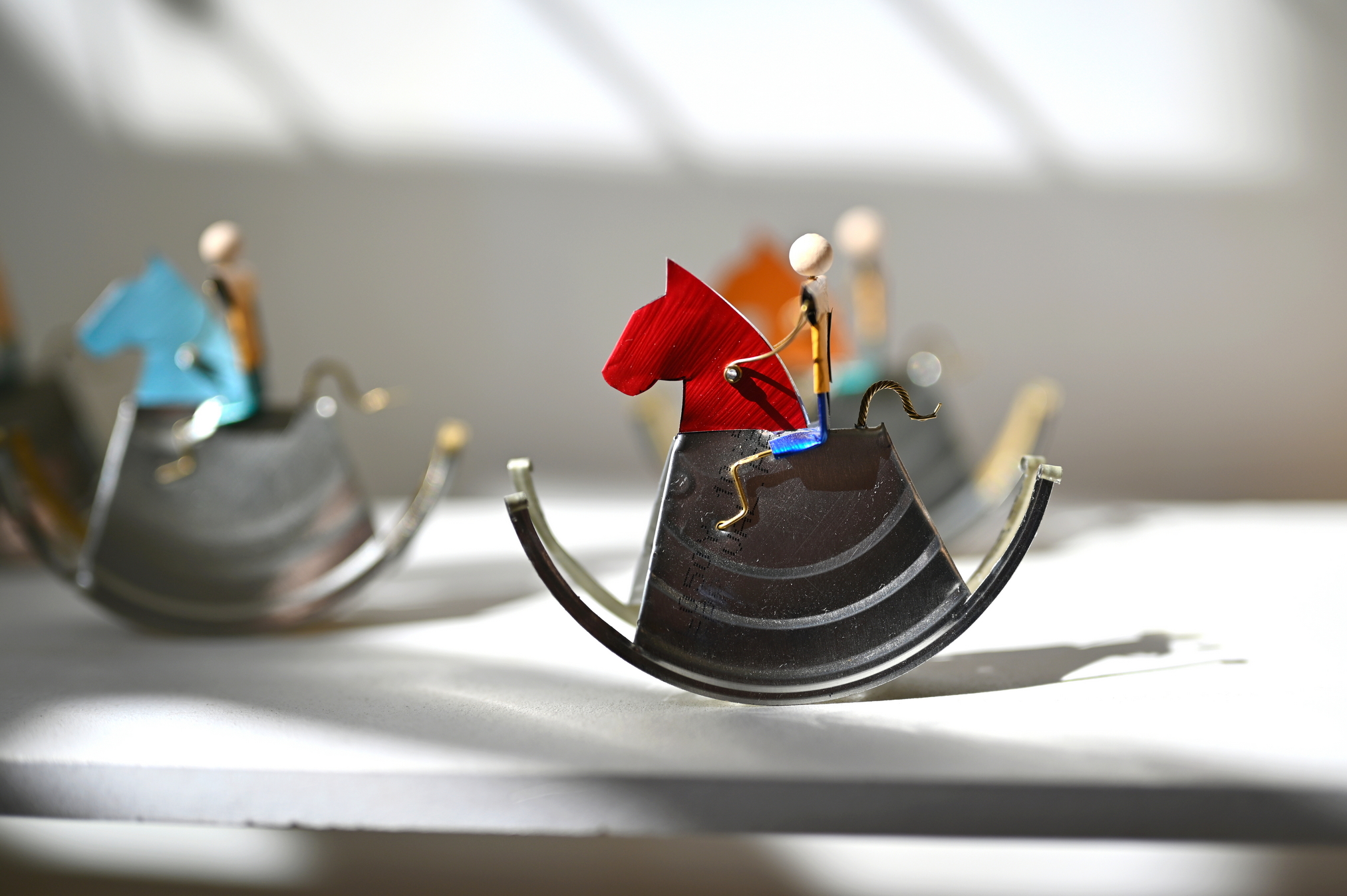
Simão was born in 1978 in João Pessoa, Paraíba, but his family moved to Brasília shortly afterwards. There he grew up giving free rein to his imagination amidst his father’s workshop, shows, street performances and workshops. “Sometimes I travelled with him to festivals,” he recalls. When his parents separated, he lost access to the array of instruments and ideas from that playful and fantastical world, but “the seed remained”.
At primary school, a classmate taught him how to make a tsuru, a bird that is one of the most traditional forms of origami. Simão perfected them and learnt other types of paper folding whilst venturing to make “small transformations” to his toys, inspired by the origami books and tool kits his mother gave him.
Apart from a few specific tools such as chisels, saws or a soldering iron, which he had to buy, Simão used recycled materials and objects to carry out his experiments. Long before him, his father had already been giving various odds and ends a new purpose by using them to create his puppets.
“When we were little, my sister and I used to sleep on a foam mattress, and he would cut strips from it to make dolls,” says the craftsman, laughing, as he recounts a story his father used to tell him. “The mattress kept getting narrower and narrower, and that’s how I became so attached to her.”
Although he cannot confirm the accuracy of these stories, watching his father reuse materials led him to follow in his footsteps. Furthermore, not having his “treasure trove of tools” to hand only heightened that need. Initially, his practice was driven by circumstance; environmental awareness would come later, when he enrolled on a Geology degree to explore the Earth’s interior with the same curiosity with which he used to take toys apart to see how they were made.
He completed his degree in 2005 and, the following year, returned with his girlfriend, Joana, to her hometown, Porto. On arrival, he was faced with a lack of job opportunities in his field. Whilst looking for other work, his hands once again found their way to reused materials and objects. “I started making things as I had before, but with no intention whatsoever of making a living from it,” he recalls.
Folk tradition, movement and reused materials
The first pieces Simão created were personalised gifts: a car carved from a tuna tin for his father-in-law, with a number plate referring to his birthday and his initials, and some dancers made from soft drink tins to give to a friend.
It was the summer of 2007 when he decided to revive another childhood passion and organise an origami workshop. He headed to the now-defunct CRAT — Regional Centre for Traditional Arts, on Rua da Reboleira, to leave a poster there, and, just a stone’s throw away, he spotted the workshop of Naná, a maker of miniature boats. The craftsman’s son invited him in, and shortly afterwards Paulo turned up – the owner of Farmácia, a craft shop then housed in the former Farmácia do Toninho da Reboleira. “It was a charming place and it stuck in my mind.”
Weeks later, he proposed holding an exhibition of toys there, but he had little more than the audacity to dream and the knowledge of some mechanisms used in traditional toys, passed down from his father. So, he took the small car and the dancing figures he’d made, crafted the girl on the swing and the girl skipping rope using wood, cork and tins, and took a few examples of each. “In the first week I sold almost everything, because I had very little stock,” he reveals.
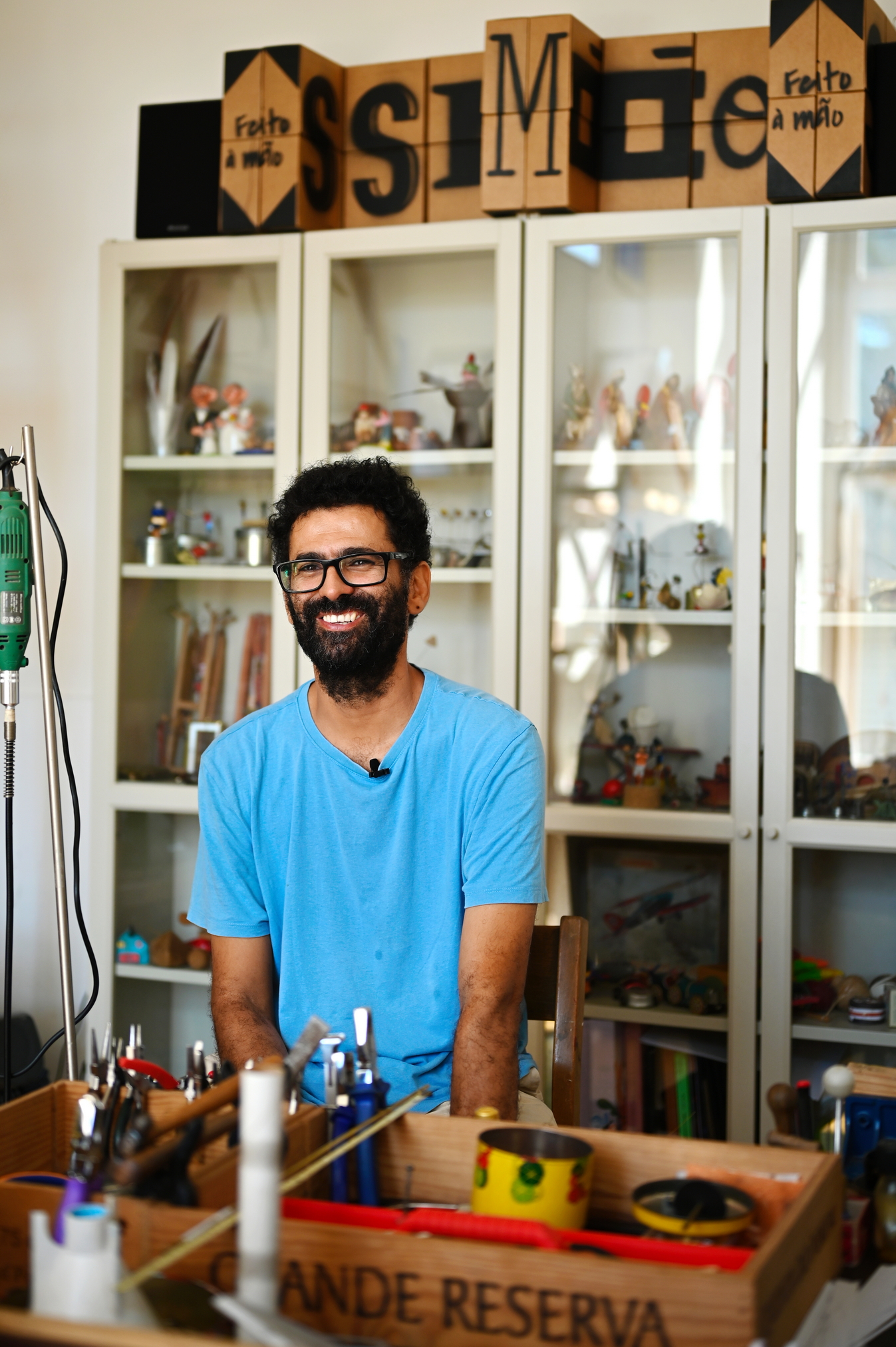
Presenting his work showed him that the reuse of materials could be, rather than a hidden feature, an explicit and distinctive trait of his works. The first version of the girl skipping rope was made of wood and had been polished and painted. “I made three of those dolls and didn’t sell a single one, because the concept of the reused [material] was lost on people, and they wanted to buy the rough brass prototype.”
Back in 2007, Simão Bolívar founded Simão Feito à Mão and, ever since, he has never stopped creating. The process begins either with an original concept that he seeks to translate into a piece, or with an idea linked to the analogy of form or the properties of the material of a particular object. “What I do draws heavily on what I learnt from folding two-dimensional objects in origami.”
Folk tradition, movement and the reuse of materials form the three pillars of the project. “Most of my toys have some sort of interactive mechanism,” says the craftsman. “You turn a handle and they move.”
Simão’s work encompasses both his own original creations and recreations of popular toys and toy mechanisms. The first category includes the car and the goat cut out of tuna tins, and the girl skipping rope, made from soft drink cans and corks. The second category includes the girl on the swing, which works on the same principle as the traditional toy known as ‘Gregório’ or ‘trapezista’ in Portugal and ‘Mané Gostoso’ in Brazil — a wooden toy with a figure that spins round in the air when its ends are squeezed.

Creating toys and the tools to make them
This last batch also includes a woman hitting her husband with a rolling pin, which follows the same principle as the traditional chicken plate. In this traditional wooden toy found in various countries, including Portugal and Brazil, the chickens are attached to a pendulum which, when set in motion by spinning or rocking the plate, makes it look as though they are pecking at the ground. Simão had created an initial reinterpretation of the toy, replacing the rolling pin with São João’s hammer and a leek, to sell at the festival. A few remained unsold, which he took to a fair in Pombal. It was a lady who, upon seeing the piece, suggested he create something more universal.
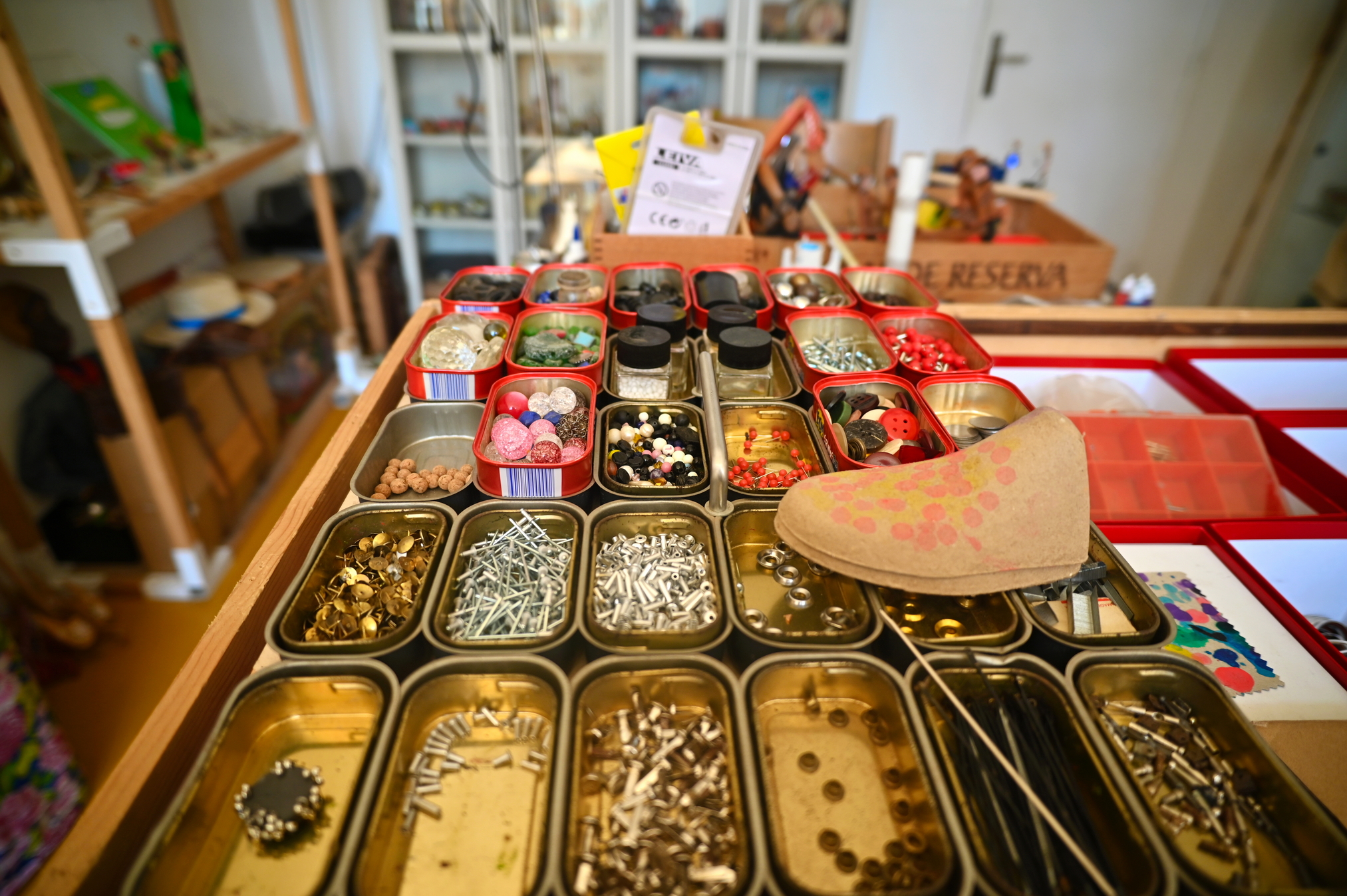
In the early days of the project, tinned food cans formed the basis of the pieces. Later came the soft drink cans. “At the supermarket, I’d choose what to buy not for the products themselves, but for the colours of the cans,” he explains, giving an example. “I need yellow, so let’s have a tonic water.” From 2009 onwards, coffee capsules began to take centre stage amongst the reused materials. “They’re an environmental problem, but they have fantastic colours and patterns and are easy to work with, because they’re made from a thin sheet of aluminium.”
Production time for the toys varies depending on their complexity. During a working day, Simão creates around 10 dancers and 10 girls skipping rope. The capsule aeroplanes, made in batches of 20, take two days to produce, as they are among the few pieces that require the use of glue. The more complex ones, such as music boxes, take several days to complete.
Usually, the materials find their way to Simão’s workshop via family members, friends, acquaintances and customers, such as his neighbour, Paula, who is his “supplier of cat food tins” — currently used as the base for most of his figurines — and an American gentleman, Gary, who is his “supplier of champagne corks” — used on specific parts of the toys, such as the heads. Before Gary came to his aid, Simão would head to Aliados on New Year’s Eve, just after midnight, with two friends and a bag. “Within minutes, I had enough corks for a year’s work.” There are materials he really does have to buy, such as brass wire, metal fittings and smaller and/or specialised parts.
Over the course of almost 20 years, the craftsman has been “streamlining processes” and “optimising methods”. Alongside creating toys and dolls, Simão develops his own tools, such as the machine for making cork heads – which were once produced one by one – and the capsule-washing machine, which prepares these items for treatment.
Although intended for play, these pieces cannot be commercially classified as toys, as they do not comply with European safety standards, containing small parts that could be swallowed and sharp metal edges. “The toys I make can be used by children, but not very young children, and they need to be ‘trained’. You pick it up and show them how to turn the handle, and they do it,” explains the craftsman, emphasising that his pieces are suitable for all ages.
Simão Bolívar points out that, in a career spanning almost two decades, “the amount of reused material is insignificant compared to the sheer volume of things produced”. He believes the real impact of his work lies in raising awareness amongst the public who interact with his pieces, even if they do not buy them. “The most interesting thing is the possibility of them developing an emotional connection with objects they throw away every day.”
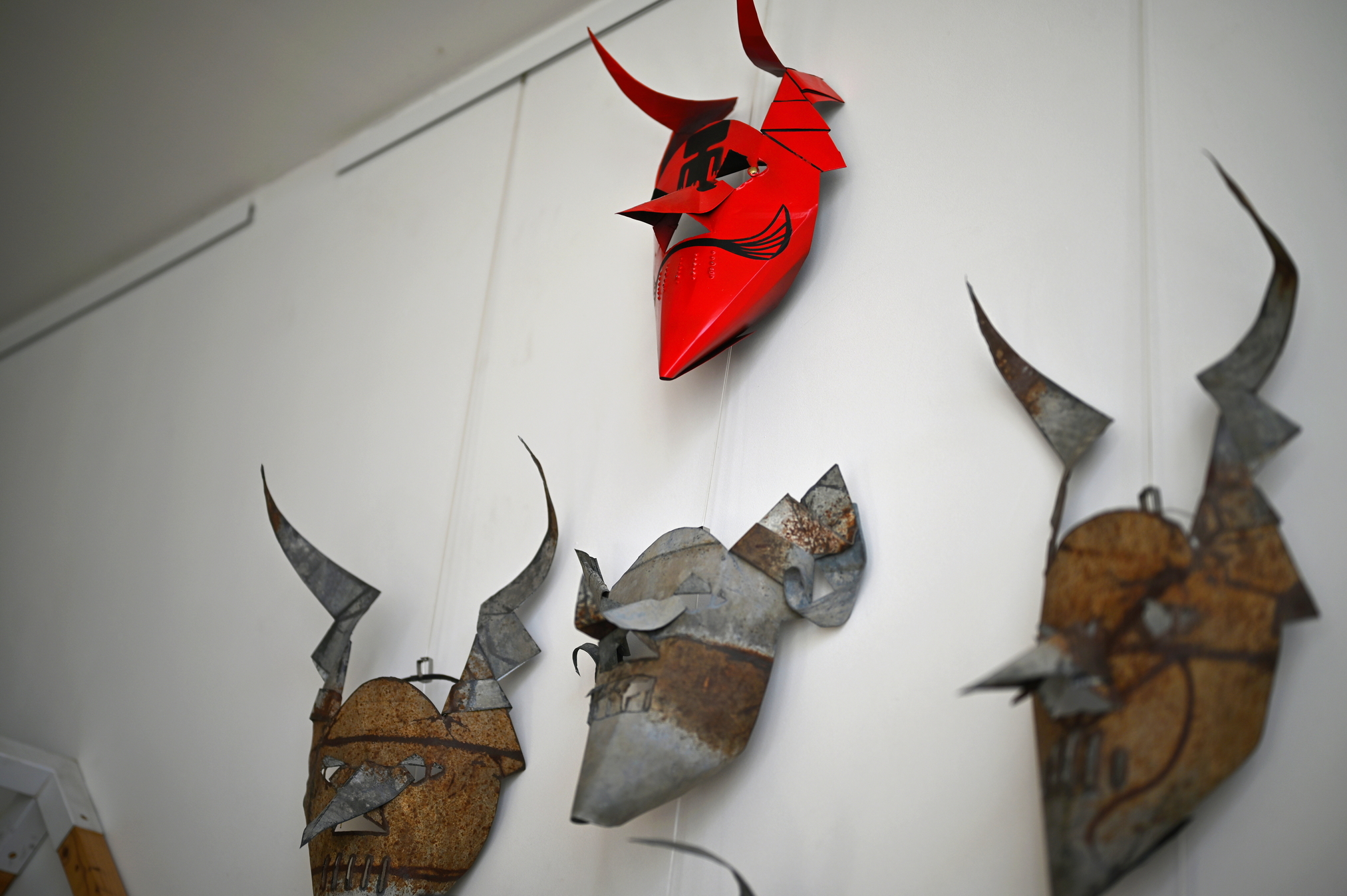
In 2012, Simão was officially recognised as a professional craftsman by CEARTE – the Centre for Vocational Training in Crafts and Heritage – which, in addition to awarding him the Craftsman’s Certificate, classified his workshop as an Artisanal Production Unit. At that time, he obtained certification as a toy maker, but in 2018 he decided to reconnect with his father’s craft and applied for a second certification as a puppet maker. This year, he began exploring mask-making and hopes to see this activity recognised in the same way.
As well as the commercial side of his work, Simão occasionally takes part in craft markets and regularly runs workshops on making sustainable toys in Porto and across the rest of the country. This month, as part of the Open Days at the Oeiras Arts & Crafts Biennial – where craftspeople from across the country are challenged to open their studios to the public – there will be two workshops on 10 and 11 October at 10.00 am at the Simão Feito à Mão space in Bonfim.
Photography © Rui Meireles
Share
Relacionados
