

EN

november 2026
Maria Eduarda Leite never outgrew the ‘why’ stage. As a child, she would entertain herself by asking questions at family dinners and dreamt of holding a proper microphone. Later on, she would annoy her circle of friends with unusual questions. As she grew up, this curious and talkative side of her was fuelled by debates and conversations her sister took her to, such as the philosophy cafés organised by the Clube Filosófico do Porto. “The first one I went to took place at the Planetarium and I found this intersection of philosophy and science really interesting,” she tells Agenda Porto.
That session was her gateway into a world where she could give voice to her concerns and listen to those of others in a simple and free way, without fear or judgement. “I was the youngest and felt like a fish out of water, but I always felt heard,” says Maria Eduarda. Her connection to culture and the arts went back a long way, to her years studying piano and classical singing, and the drive to set up her own project gradually took shape, fuelled by the activities and groups she organised and took part in at university.
The completion of her studies – a bachelor’s degree in Communication Sciences and a master’s degree in Management – coincided with the end of the pandemic. In 2023, taking advantage of the restoration of normality and the decline in the “cultural lethargy” that had prevailed at the time, and having already gained “some professional experience”, Maria Eduarda founded the Tagarela Collective. “I wanted it to be a place where people felt at ease expressing their opinions, developing their reasoning skills and looking at philosophy as a more accessible discipline,” she reveals.
© Espaço Agra
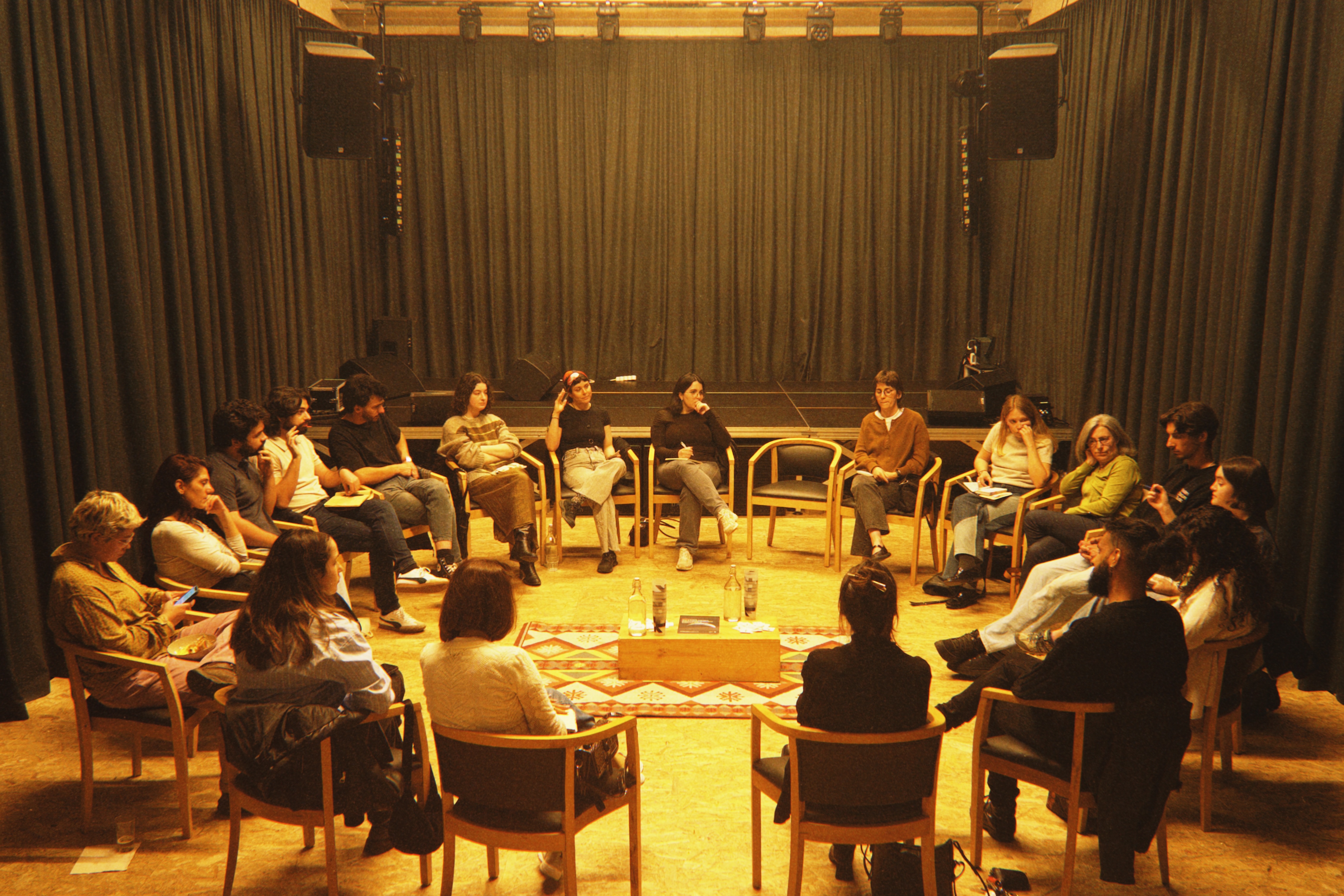
The first debate focused on art and took place in September of that year, as part of the Colors Festival at Espaço Agra. Although it did not yet have a name, it was the precursor to the Café Filosófico, which now takes place twice a month. Accessibility is at the heart of these gatherings, which are aimed at anyone interested in discussing topics relating to philosophy and everyday life. “It’s not a prerequisite to know anything about philosophy or authors such as Kant or Descartes,” she emphasises. “Even those who have never read a book or who cannot read or write can take part.”
For the founder of Tagarela, creating a “space for dialogue that gives the floor back to the public” is particularly relevant in an increasingly frenetic and polarised society. At the same time, she believes it is necessary to “democratise access to culture”. “Sometimes there’s a perception that these spaces are overly intellectualised and full of abstract concepts.”
Questions are everywhere
In designing the Café Filosófico, Maria Eduarda Leite drew inspiration from the approach of a former philosophy teacher who, rather than simply reciting authors and theories, challenged her pupils to engage with them through dialogue and to form their own opinions. She also took the format of the Clube Filosófico do Porto as a model for creating “a place for communion and sharing”.
The Café Filosófico is divided into two parts: in the first, which lasts about an hour and a half, the initial question is discussed; the second is devoted to ‘metadialogue’, where participants can give their views on the model used, report any difficulties or make suggestions. Maria Eduarda moderates the debates with ‘an inquisitive and curious attitude’ laced with humour. “These kinds of events tend to be tedious, and by making jokes, people relax and realise they’re allowed to make mistakes.”

© Nuno Miguel Coelho
As the founder and moderator of the initiative, Maria Eduarda has to come up with the topic and organise the moderation, promotion and logistics for the sessions. Coming up with the opening question takes the longest. “I’m really into linguistics and semantics, so I spend a lot of time thinking about the double meanings of words or which direction a person’s thoughts might take if I put the verb before or after the noun,” she explains. As a rule, this is a phase involving extensive research, which may include reading the works of leading figures in philosophy or thought, but is not limited to them.
“Many questions come from thoughts I have in the shower, from films I’ve seen or from conversations with friends,” she says. This was the case with recent topics such as ‘Can we truly know someone?’, inspired by the film The Drama, or ‘Do we think in words?’, which arose from a conversation with work colleagues.
The discussions follow a set of rules. “Respect and good manners are guaranteed from the outset, but it’s always worth emphasising this,” she says. Participants must raise their hand to speak and, once given the word, clarify whether they are going to answer the question, disagree with and/or counter someone’s idea, or raise a new point. “This requires an exercise in reasoning and organising one’s thoughts, which people are not used to,” says the moderator. Waiting before speaking is equally crucial. “Many say it is difficult, because they are impatient and want to react, but the rule ultimately curbs some of that impulse.”
© Imagens de Verdade
Building the debate together
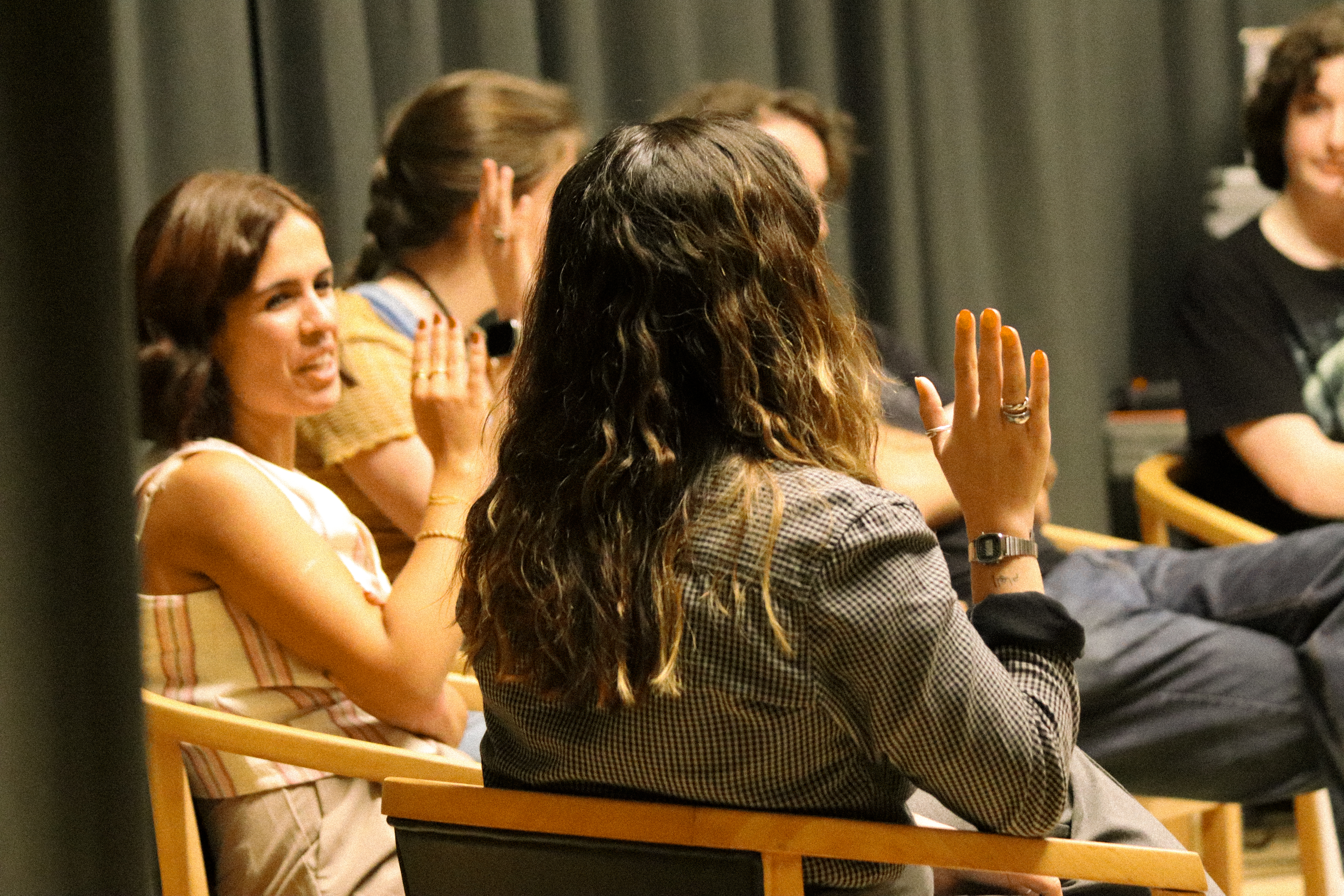
Each Café Filosófico welcomes around 20 people from a variety of backgrounds, ranging from extroverts who are used to voicing their opinions to shy people who are afraid to speak in front of strangers. Many are keen readers, though not necessarily of philosophy, and bring literary or cultural references to the table. Others draw on everyday experiences and things they have heard a friend or family member say to form their reflections. Age also varies; the youngest person at a session was 18 and the oldest 79. There are several ‘regulars’, but new people turn up every month. The discussions get full very quickly, so they’ve moved to holding two sessions a month instead of just one.
According to Maria Eduarda, the most stimulating part of the sessions is seeing the group set the direction of the discussion rather than simply following prepared ideas. “Sometimes, I think they’re going to explore one path, and the question takes them down another,” she observes. This is where Tagarela embodies the collective spirit implied by its name and “sets itself apart from other debates or casual conversations”.
© Espaço Agra
Three years on, the Café Filosófico has found a permanent home at Espaço Agra, having taken its first steps at A PiSCiNA. “It’s very important that there are venues capable of supporting these independent projects, which aren’t always the most profitable,” she emphasises.
The Tagarela Collective organises other formats, such as Conversas a Pares — quick meet-ups that challenge participants to get to know people outside their social bubble — and Café Filosófico nas Empresas, a tailored training programme that challenges teams to test their reasoning and powers of argument, and to develop their communication and listening skills.
In addition, Tagarela has already taken part in events such as the Podcast à Mesa organised by Maus Hábitos and the Absurda Art Fest in Arcos de Valdevez. The next step will be to try out "lighter and more relaxed" formats and forge new connections, seeking new synergies and opening the door to different audiences. For now, the conversation continues at the next Café Filosófico, on the 11th and 24th, at 9.00 pm.
Share
Relacionados
