

EN

If there is a natural habitat for the underground scene, it is, quite literally, a cellar. For the past year, the basement of number 86 Rua de António Granja, in Bonfim, has been hosting bands that have never, or only rarely, performed live. The venue forms part of the yellow-tiled building which, since 1959, has been home to the Real República dos LyS.O.S., a community made up of young people studying in Porto. TRASGO, Socafofo, Kodakino, Varizes, Esquizofonia, Gato do Mato, Banda Humilde and Folgosa Cadafaz are the groups that have already played there, most of them coming from across the road, from the rehearsal rooms at the Stop Shopping Centre. “It’s easier in terms of getting there; I usually go over and help carry everything,” says Rafael Fermento, a 23-year-old multimedia student and member of TRASGO, the first band invited to perform at LyS.O.S. “I’d made up my mind before, but after playing here I wanted to move in,” he recalls. Once settled in, and after seeing a second band fill the basement venue, he suggested to the rest of the collective that they start a regular programme. Since February, the Concertysos have been taking place on the last Friday of every month, always at 7 pm, with free entry and a maximum capacity of 100 people.
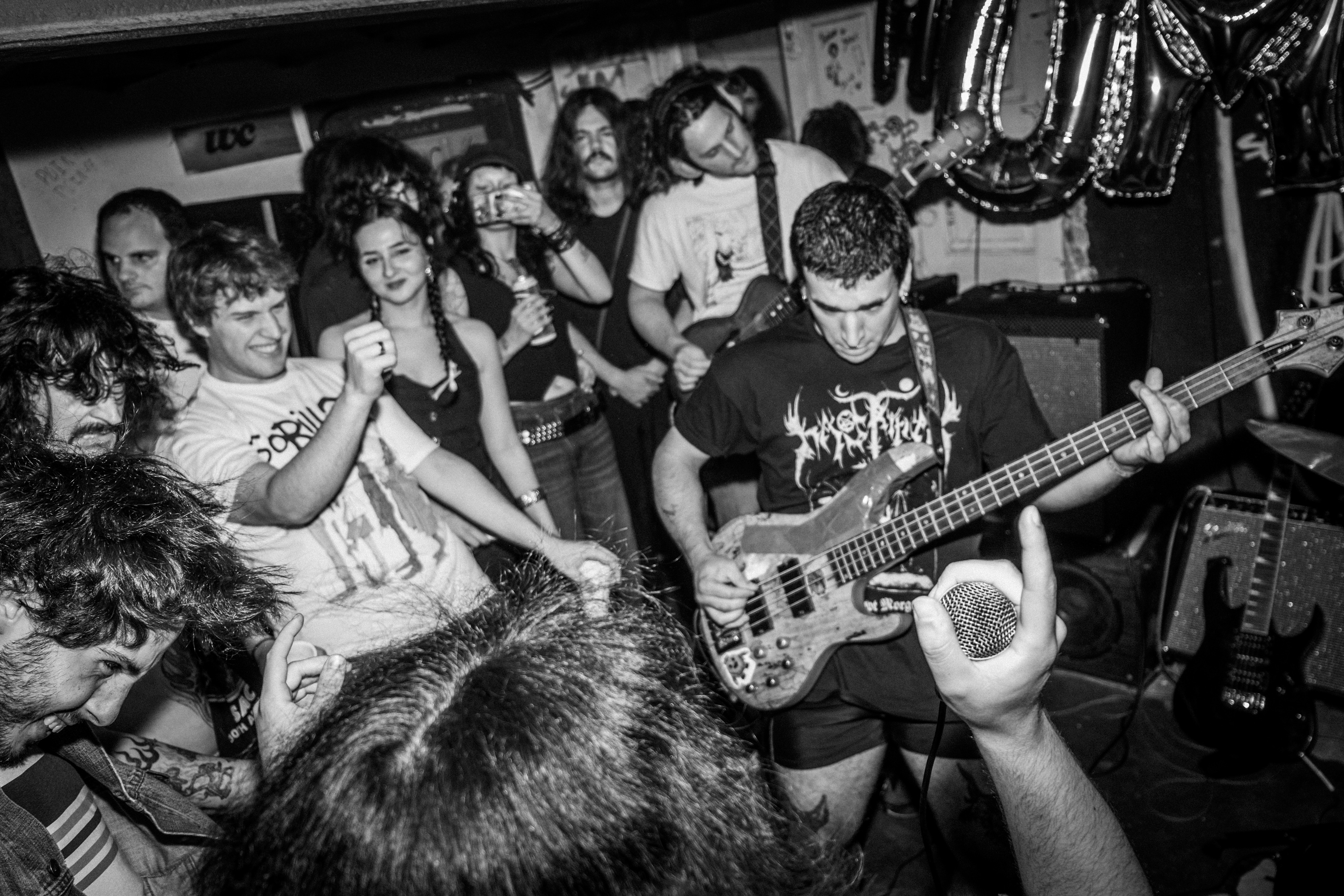
A concert by Banda Humilde last July, featuring Rafael Fermento on bass © Mafalda Silva Pinho
What they manage to earn at the bar at each event “isn’t much”, but it’s enough to organise the next one, explains Diogo Teixeira, aged 25. This postgraduate student in Communication Sciences, originally from Mirandela, adds that as soon as they have the “means”, they want to start paying the musicians, “because they deserve it”. Fermento adds that they try to ensure the bands “don’t lose a single penny”: “they get food, they get drink, even backline equipment; often it’s my band that brings the drums and the amplifiers”. According to him, “there aren’t many venues in Porto” that serve as a “stepping stone” between a band’s formation and their arrival at venues such as Maus Hábitos, so this series of gigs aims to help bridge that “gap” between stages. “As LyS.O.S. is a community venue,” he says, it makes sense for it to position itself as a “counterculture venue in Porto”, hence the focus on “unknown bands”: “since we can only offer these conditions, let it be to projects that will benefit from this initial visibility”.
Just as important, if not more so, than this showcase is, of course, the enjoyment of residents, musicians and visitors alike. “The idea is that nobody should lose out,” they assure us, but ensuring that the concerts run smoothly can also be “stressful”. They therefore want to alternate them with a sort of “more laid-back party”, such as a recent evening event that combined a DJ set with a Tekken video game tournament. The Cinelysos screenings are currently on hold: “We plan to return, with the idea of having live music whilst the film is showing, but we’re still trying to fit that into our monthly schedule, so it doesn’t end up being a total financial loss, because it’s much harder to get people to come and watch films and it always means we have to provide food and drink…”, reveals Diogo.
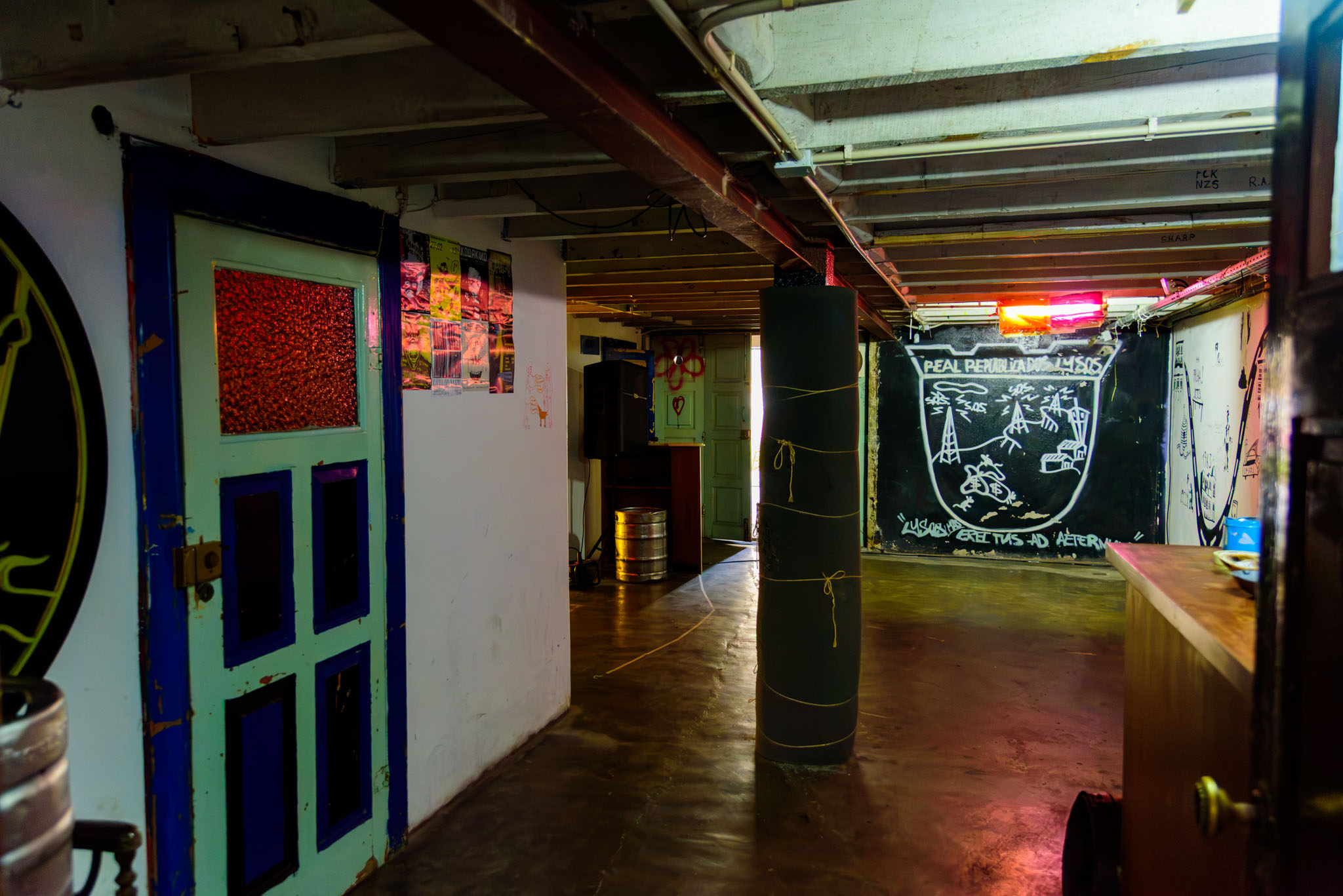
It is in the residence’s basement that the Concertysos, parties and other activities are organised © Mariana Rollo
Different living arrangements and the status of emancipation
Student republics became widespread in Coimbra in the 19th century, following the Liberal Revolution, inspired by student communal houses dating back to medieval times, where expenses, meals and daily life were shared. Their internal organisation can resemble that of a republican state, hence the name. At LyS.O.S., too, domestic management is shared by everyone, with a “focus on each person’s strengths”, as Rafael puts it. Together, they manage the accounts, decide what to buy and take care of the cleaning and maintenance of the communal areas. But it was actually students from the city on the River Mondego who founded the house, when “they came to Porto in 1959 to finish their degree”, explains Diogo Teixeira.
To put this into context, the native of Trás-os-Montes points out that there are 24 halls of residence of this type in Coimbra and that they all form part of the Council of Republics, a body for coordination and joint decision-making. “In this regard, the LyS.O.S. were always somewhat marginalised, until the 1990s or 2000s when they established closer ties with Coimbra.” The only student residence in Porto only accepts higher education students, unlike some of those in Coimbra, which also accommodate workers; but the main difference, says Diogo, is that they are a cooperative.
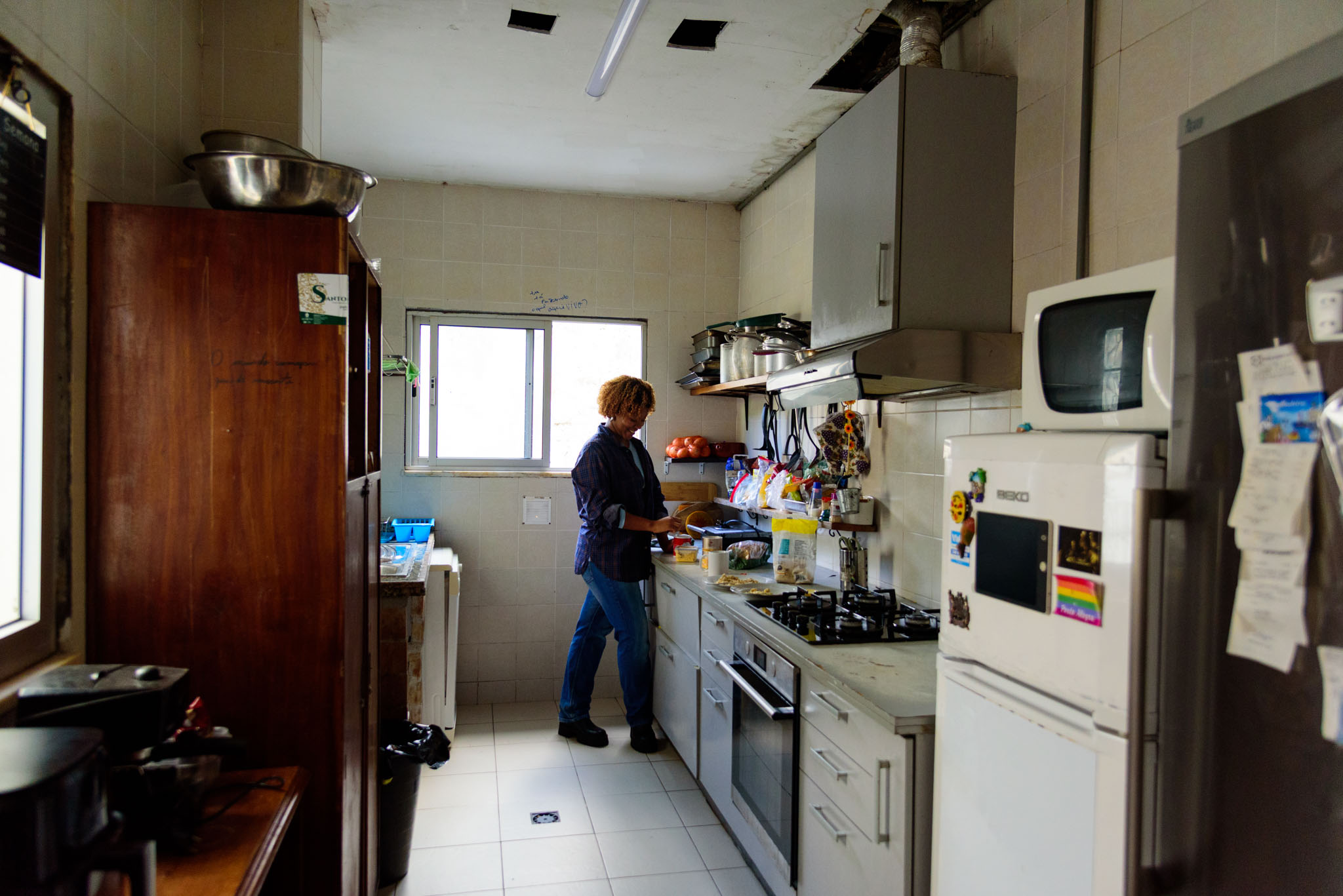
The bills, shopping, food management, cleaning and maintenance of communal areas, and organising events: everything at LyS.O.S. is handled collectively © Mariana Rollo
Originally established in Praça de Mouzinho de Albuquerque, in a building that no longer exists, the residence moved to Avenida da Boavista in the 1960s. There, a conflict sparked by “issues relating to hazing”, as Teixeira explains, went so far as to cause “a split”, but once peace was restored, the problems continued. The construction of the Brasília Shopping Centre forced another move, and in 1972 they moved to Rua de Faria Guimarães, where, during the ‘Hot Summer’, they even hid two dozen anti-fascist activists (one of whom was António Regala from Aveiro, who lived in the house).
The greatest crisis and the greatest achievement were to come at this address in the following decade, when “the landlord passed away and his daughters wanted to sell the house and evict them”. At the time, “there was a law protecting student halls of residence from eviction, but it only applied to Coimbra”, so “the students from Porto went to the Assembly of the Republic and managed to make the law national”, continues Diogo. The result: the heirs were obliged to compensate the LyS.O.S., who, with the money received, bought the current building in Bonfim. “It was there, in 1987, that the co-operative was founded; none of them could remain as owners of the house, because eventually they would finish their degree and move out.” They hold “two general meetings a year”, at which the executive members “come to see how the house and the atmosphere are, to get to know the people who are here, and to approve a range of legal matters, such as the Annual Activity Plan and issues relating to building works…”.
Four decades on, their cooperative status continues to protect them. “Here in the centre of Porto, it’s absurd,” says Teixeira regarding housing rents, aware that the 150 euros each of them pays in monthly rent pales in comparison to the amounts demanded of many students. “We are our own landlords; the cooperative is our landlord.” Standing beside him, João Sabina, a 21-year-old student from Estarreja studying Management and International Trade, highlights another aspect: “We’re independent; we have no links to the University of Porto, [whereas] those in Coimbra are basically tied to the university.”
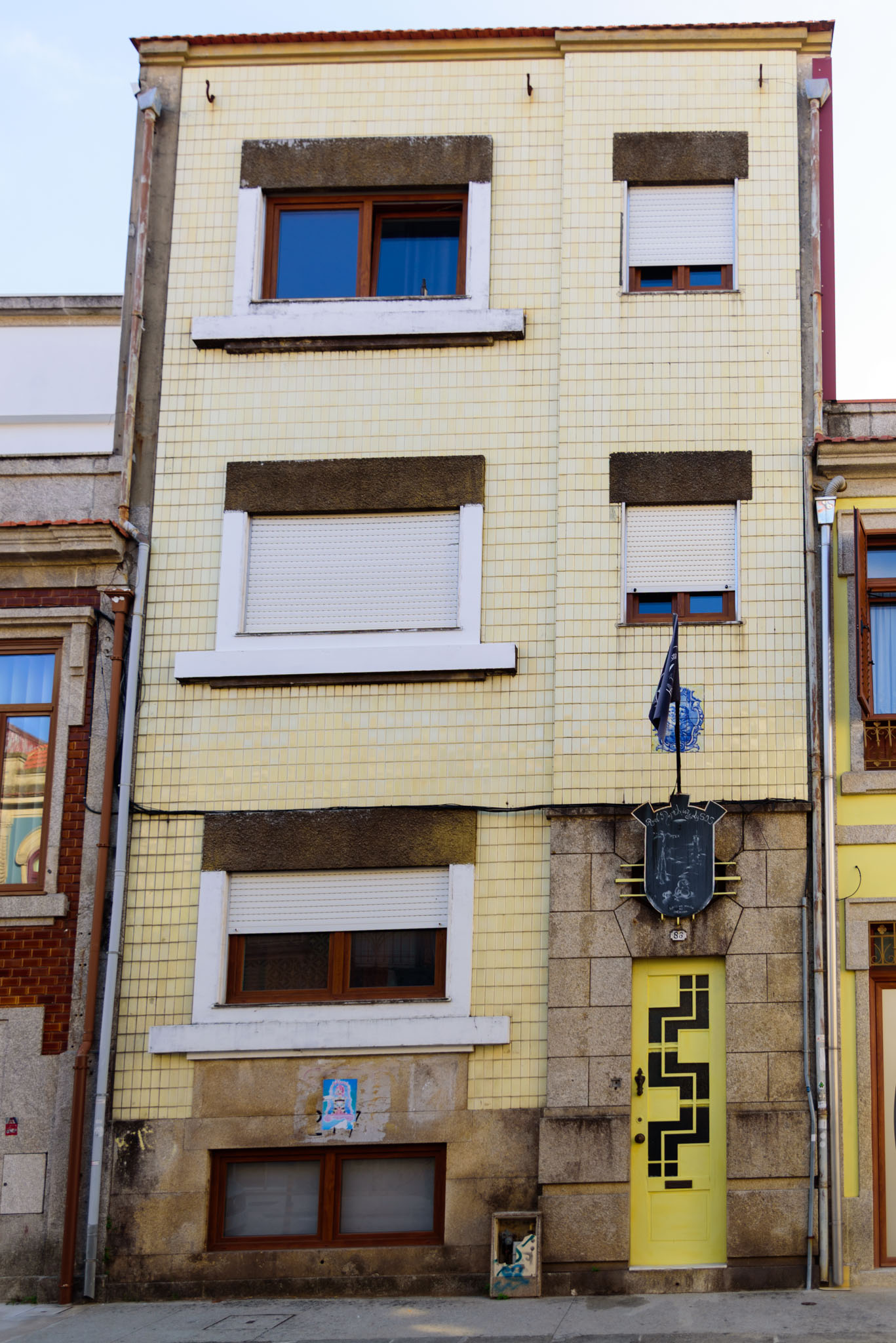
The LyS.O.S. building on Rua de António Granja © Mariana Rollo
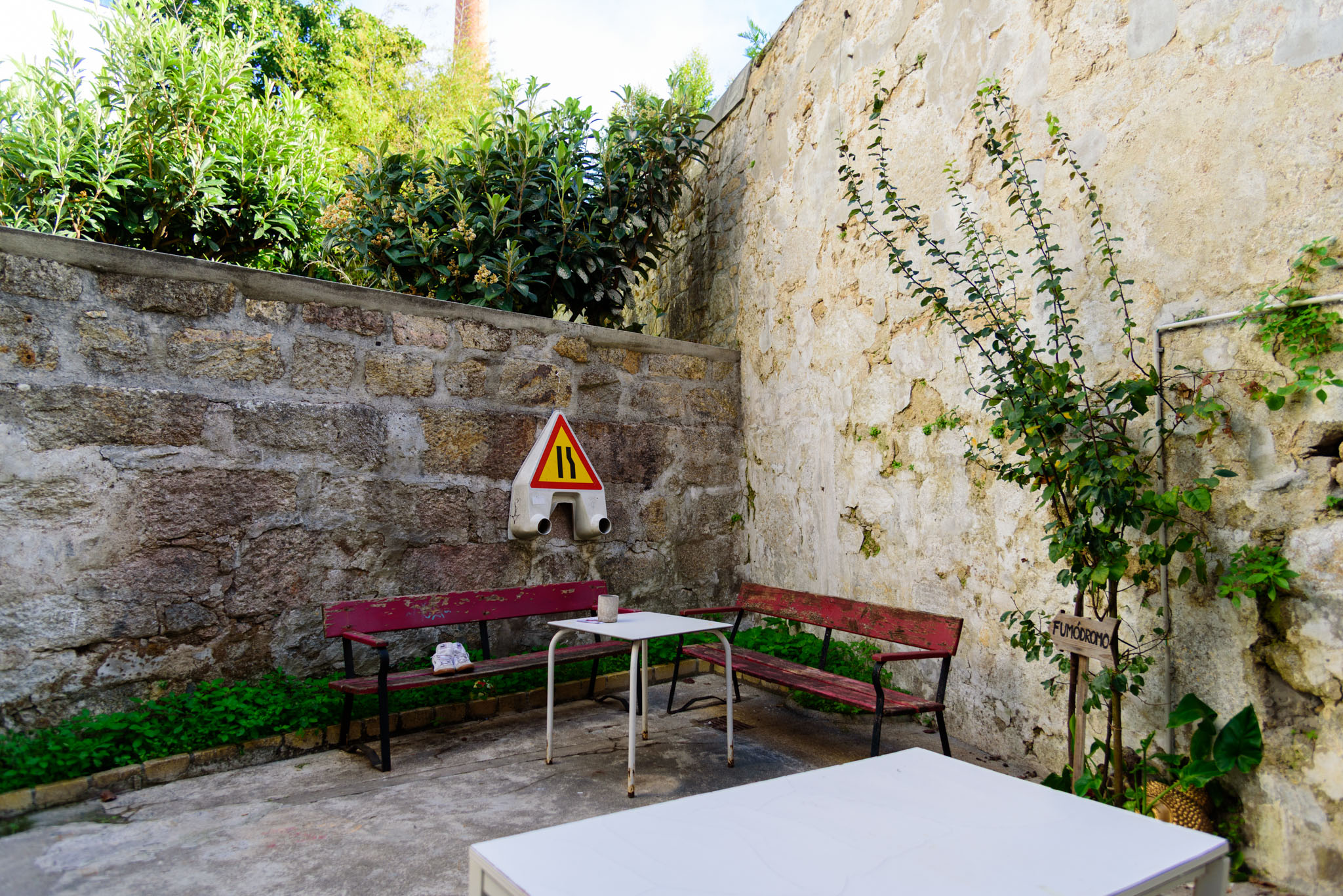
The Cinelysos screenings took place in the house’s outdoor courtyard © Mariana Rollo
Republicans, candidates, hangers-on and the end of the old ways
Despite this autonomy, the Royal Republic of LyS.O.S. has, over the years, made “several attempts to forge closer ties with the University of Porto or a specific faculty”, which have so far proved fruitless, says Teixeira. Also, unlike most student halls in Coimbra, the one in Porto “has always had a hazing culture”, he admits, “probably even before it became co-educational”. After a few trials, the hall began accepting female residents in 2012, and since then they have actually made up the majority (although none took part in this conversation).
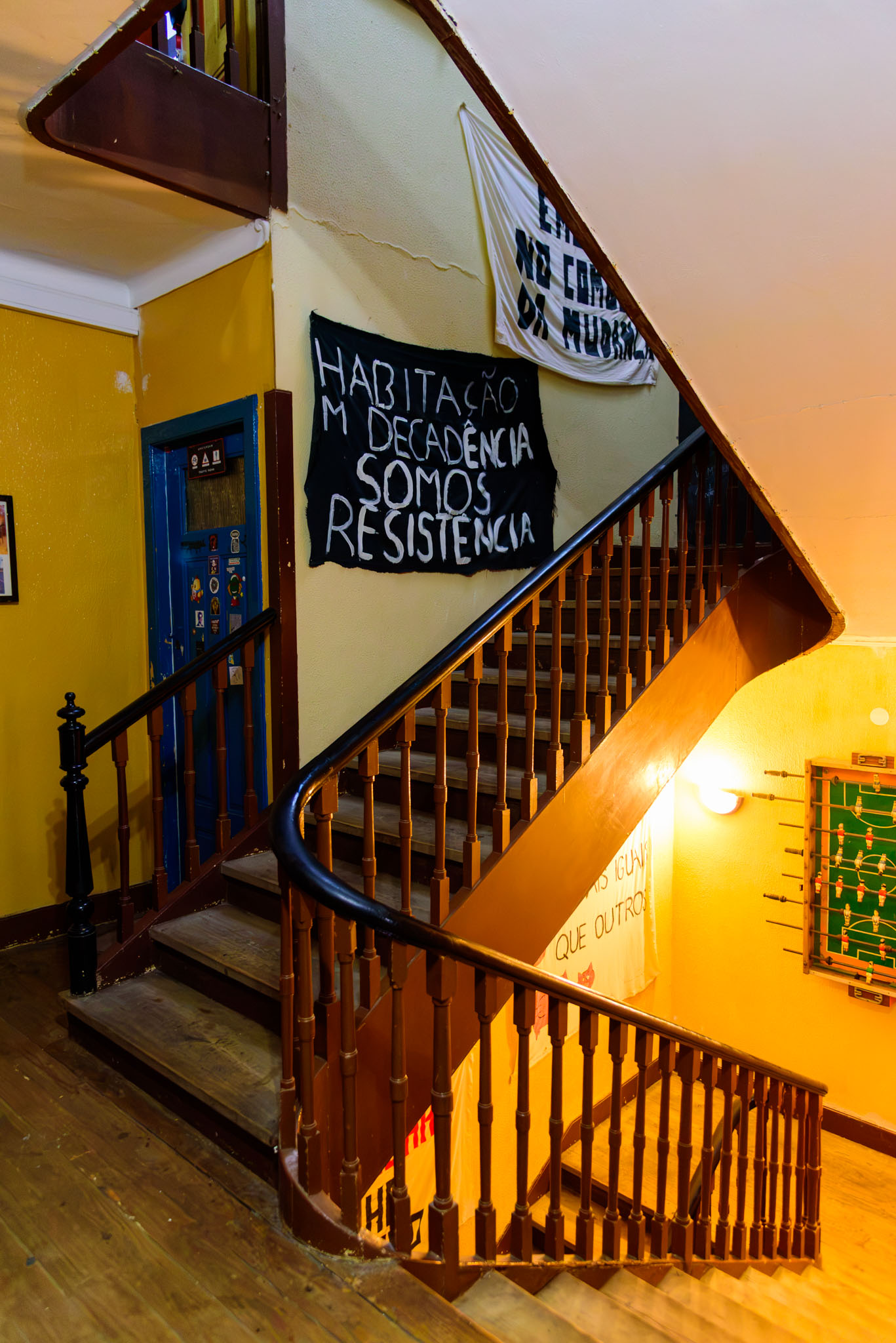
The house has five single bedrooms and four double bedrooms © Mariana Rollo
“Attitudes have changed” and the hazing rituals “are gradually disappearing”, which forces current residents to “navigate sensitivities” and face “criticism from the older residents”, who lament that the initiation ceremonies are no longer as they were in their day. It is at this symbolic ceremony, after roughly a year, that the new residents transition from candidates to full members of the hall of residence. It is a “mini-hierarchy”, as João Sabina calls it, which determines “who stays” and who does not. “There used to be the figure of the ‘mor’, above the residents,” explains Diogo, but the relationship ended badly. “The last ‘mor’, or one of the last, became associated with negative things: he took money from the kitty, left the house without any funds, and concentrated certain powers in his own hands”, thereby subverting the original idea behind the role.
There are currently 11 residents, from different fields of study and universities, but there is space for 13, spread across nine bedrooms. Previously, the priority was to accommodate students who were not from Porto or neighbouring municipalities, but this is no longer the case (Rafael Fermento, for example, is from Porto). Nor are there any nationality restrictions; they have hosted several foreign students in the past and currently have three Brazilians staying with them. “We clearly have a stronger connection to Brazil, which is natural, but we recently welcomed an Italian as well,” says Diogo. They “always have one or two places for ERASMUS students”, whom they call ‘penduras’ (short-stays), because they only stay for “six months or a year” and are “relieved of the responsibilities of running the house”, except for looking after the premises.
At the start of the current academic year, they received enquiries from “a great many people” who wanted to live there and had to “make a selection”, explains Diogo. They usually invite those interested to visit the house and have dinner or a snack with the residents, “so they can get a feel for the community dynamic”. Age may be taken into account to facilitate harmonious living, and they always give priority to first-year undergraduates, “for the sake of continuity”, avoiding residents who stay for only a short time so as to prevent “gaps between generations”.
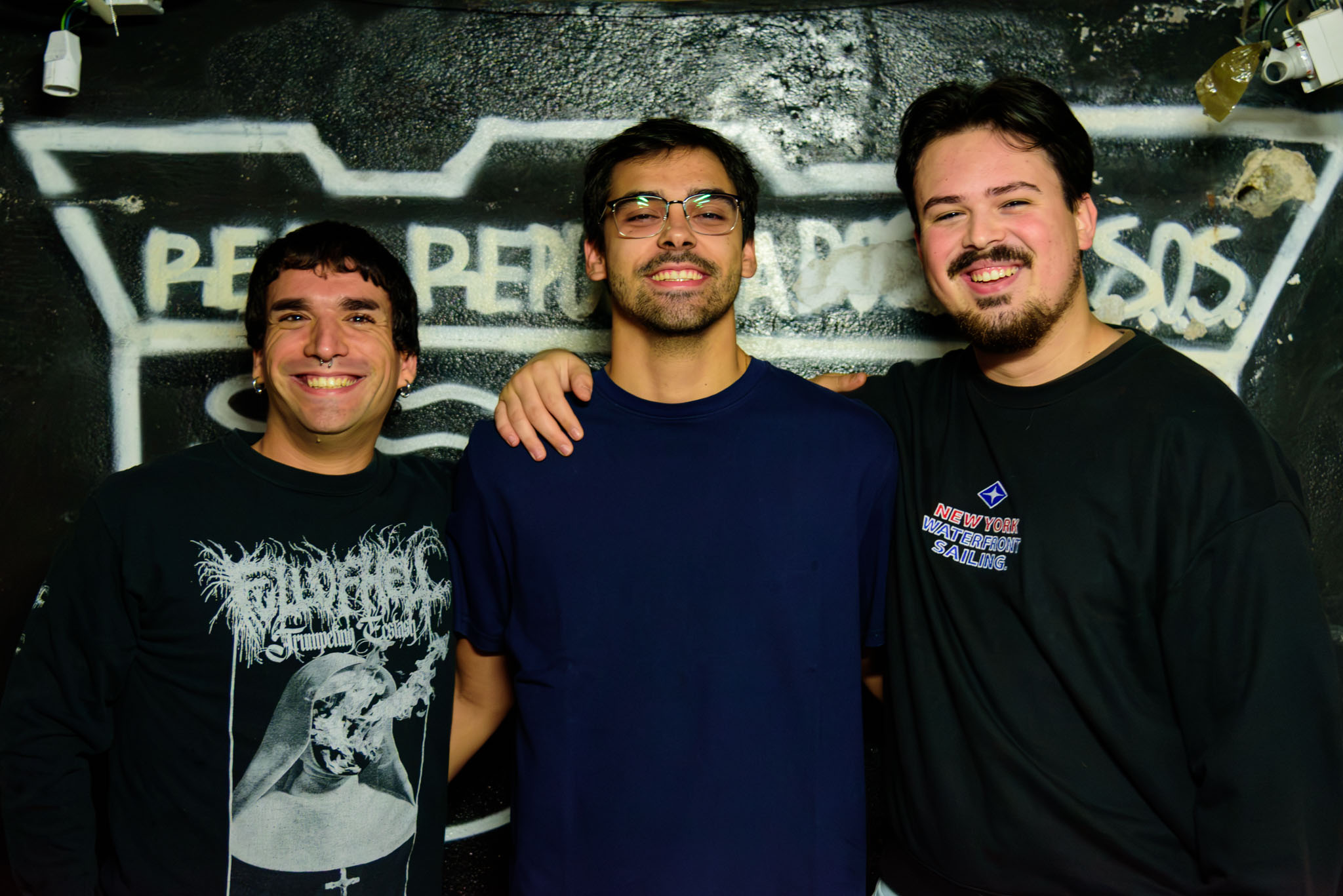
From left to right: Rafael Fermento, Diogo Teixeira and João Sabina © Mariana Rollo
Another centenary on the horizon
According to academic tradition, spending a year in a hall of residence is like living a century. Instead of birthdays, centenaries are celebrated. On 18 November, the LyS.O.S. will therefore be celebrating 6,700 years. “It’s usually the big event of the year here,” Diogo tells Agenda Porto. The celebration, scheduled for the following weekend, will feature a get-together between current and former residents, a football match pitting one group against the other, a lunch bringing together “all generations” – including the two surviving founders – and the initiation of the new residents. Despite the initiation ritual, the party is primarily for those who have lived in the hall of residence – “the alumni” – even though the costs fall to Diogo, João, Rafael and the rest of their fellow residents, as does the aforementioned task of “managing sensitivities” between the generations.
As well as the centenary, they also celebrate Christmas with their families, and at São João they organise a party for anyone who fancies turning up. “I think the house has always had its doors open to everyone, and it still does, not least because all sorts of people turn up at the events,” says Sabina. Fermento adds that they also often receive visits from people interested in seeing the house who contact them via Instagram. “When I first came here, the people I knew had no idea what a student house was, or even that there was one in Porto,” recalls Diogo. A concept which, they say, remains unknown to the majority of the city’s students.
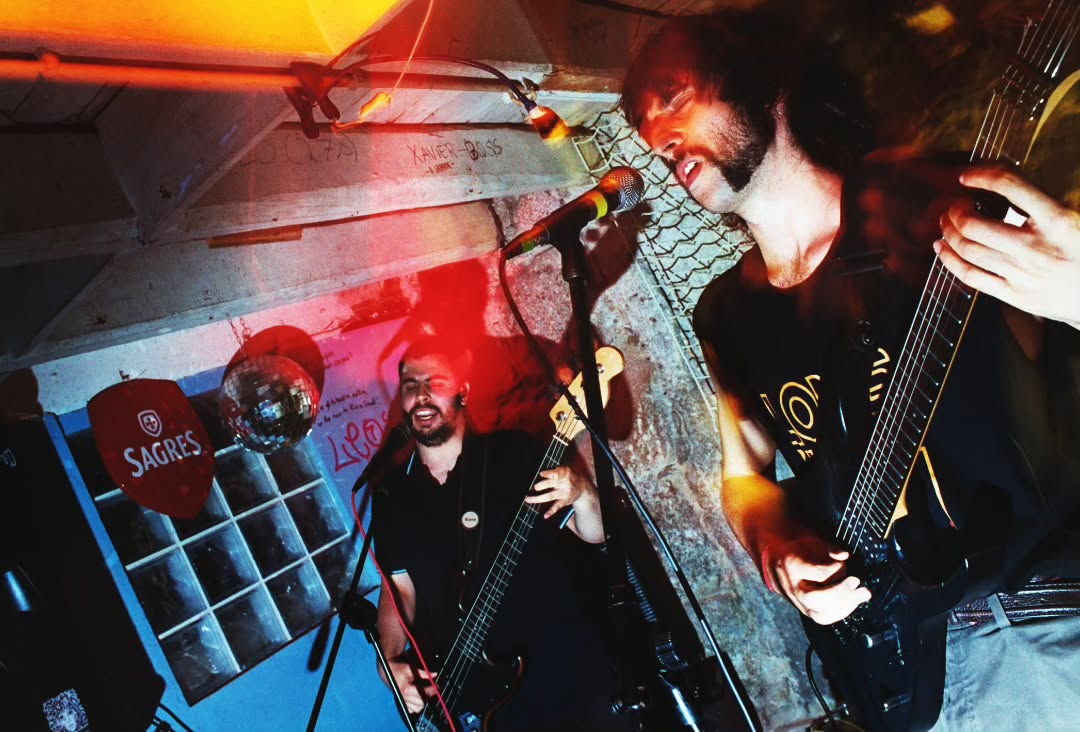
Concertysos: a performance by Folgosa Cadafaz last September © Mariana Rollo
As the conversation draws to a close, Rafael asks to pass on his thanks to Pedro Ledo, from the Astra Vaga project: “He was the one who lent us the mixing desk, and that’s really helped us; it’s lovely that we suddenly feel part of the community and that everyone wants this space to continue to exist”. A sentiment that will certainly please Zé Veloso, a former resident at LyS.O.S. and a member of Os Álamos, a well-known Portuguese university band from the 1960s, who later became a champion of academic traditions and wrote Os Lysíadas: A epopeia dos LyS.O.S., a story of a Coimbra student house in Porto. A story to which new chapters continue to be added.
Share
Relacionados
